How is Okto aiming to solve the Web3 UX?
Diederick Jacobs
03-03-2025
5 min to read
Is the Web3 Experience Cooked?
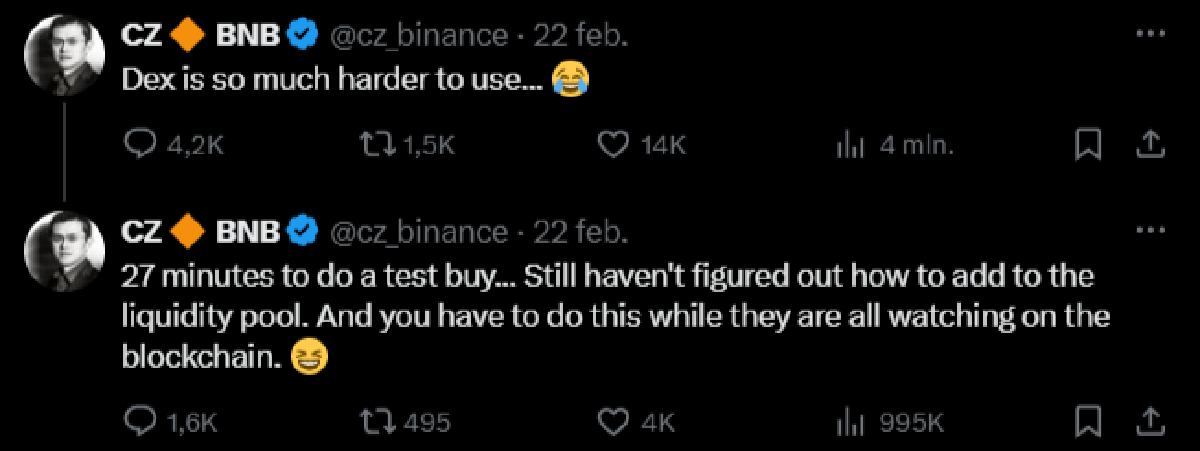
In the past week, @cz_binance, founder and former CEO of Binance, has expressed his thoughts about decentralised exchanges (DEXs) and the horrible Web3 user experience (UX) involved. If a founder of arguably one of the most successful Centralized Exchanges (CEXs) cannot navigate this space, can we expect your average Joe to do so? Or can we conclude that @cz_binance is a goofball?
“I wanted to put a few BNB in TST LP, as a test. I seen demos of Pancake before. It looked so simple. I thought, how hard could it be? But I forgot my IQ level.” - @cz_binance
The Web3 UX Maze
The Web3 UX is a rollercoaster, not full of joy but rather the opposite. It is filledwith redundancy and complexity, making it a digital nightmare. Here are some basics: A Web3 user often needs multiple wallets. Metamask will get you far, but what about non-Ethereum Virtual Machine (EVM) compliant chains like Bitcoin? Solana? SUI? APTOS? SEI? The list goes on.
The next pain point in the Web3 UX is that the user needs to store the seed phrases of all his wallets individually. The funds are gone if the user loses access to these seed phrases. Remember that the user needs multiple wallets to navigate his favorite chains, precisely as blockchains come and go in the ever-changing and fast-paced crypto industry. A good example is SUI, which became relatively popular within a few months, as TVL increased from 500 million to over 2 billion within 6 months.
Liquidity flows like water; it always flows to the lowest point, or in other words, where it is most needed. Therefore, it is safe to say that if the financial incentives are significant enough, capital inflows will happen over time, right?
In Web3, this is not necessarily the case, and that is due to the overwhelming barriers of entry to bridge your capital over to a new chain. Users must move their money through a blockchain bridge by signing multiple transactions and praying everything will be OK. However, this is not a familiar experience as one would have in Web2. Thus making the experience very surreal and confusing for new users.
Let’s assume you made it; you finally got your funds on Solana and can finally buy your favorite memecoin. Oh, never mind. We forgot about gas fees. Oh, that’s unfortunate; how do you get your Solana? Possibly through a Centralized Exchange, but that defeats the purpose of using the DEX in the first place.
We didn’t even go into depth into the hurdles you must overcome to get the best pricing (i.e. routing) while using DEXs. This extended example shows the hilariously bad UX and how many balls an average user has to keep in the air to perform relatively simple stuff.
Developers, Developers, Developers
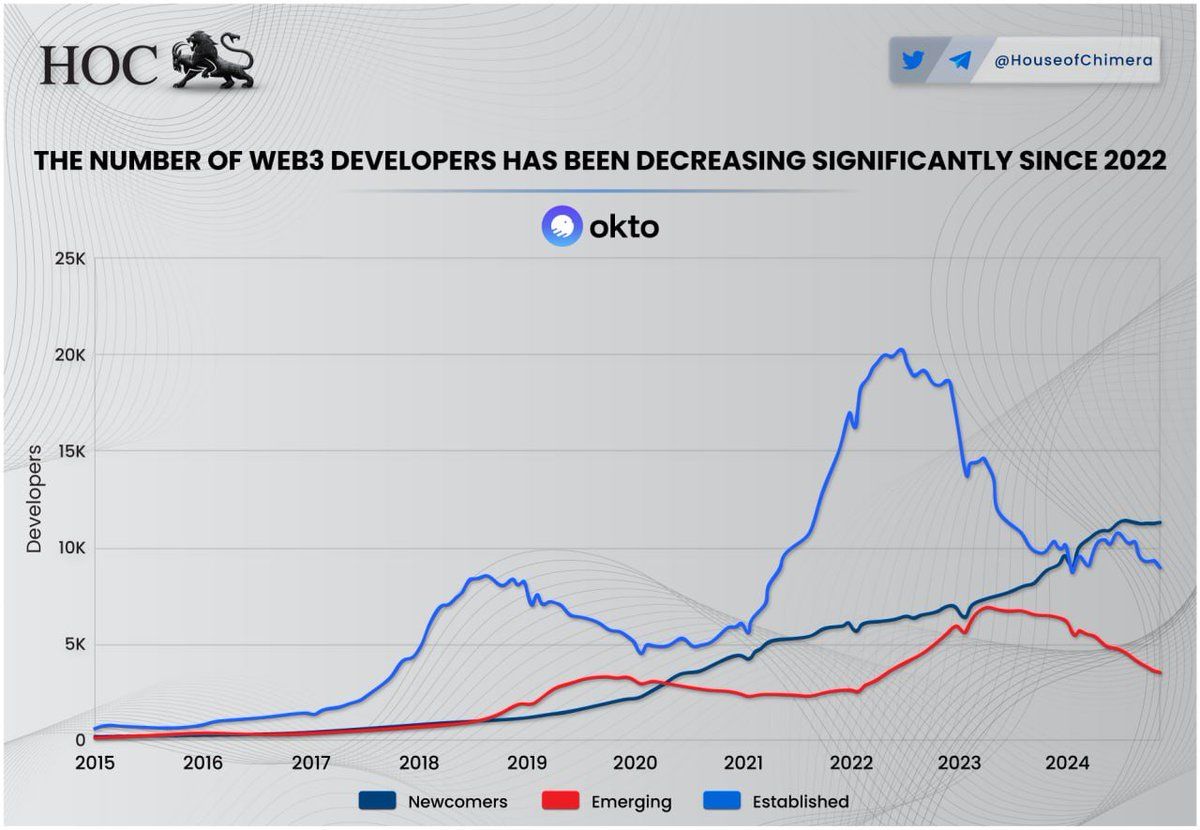
It is no secret that the number of Web3 developers has been dwindling for months now. We’ve been posting about it regularly, as the number of developers has decreased to ‘just’ 23,000 monthly active developers from 31,000 in 2021. The reason for the significant decrease is pretty broad, but it roughly comes down to the Developer Experience being equally bad as the Web3 UX.
In Web2, one can use a lot of libraries and packages (e.g. SDKs), making development significantly more efficient and more plug-and-play. The Web3 developing environment is more scattered and less mature, making developing more time-consuming and frustrating.
The Lightbulb Moment
It is not all bad news here; some light is on the horizon. The horrible state of DevEx and UX in Web3 is being agreed upon; thus, there is an increasing focus on improving these areas. Within the Chain Abstraction space are a couple of incredibly innovative and forward-thinking projects, such as Enso, Particle Network, and Okto.
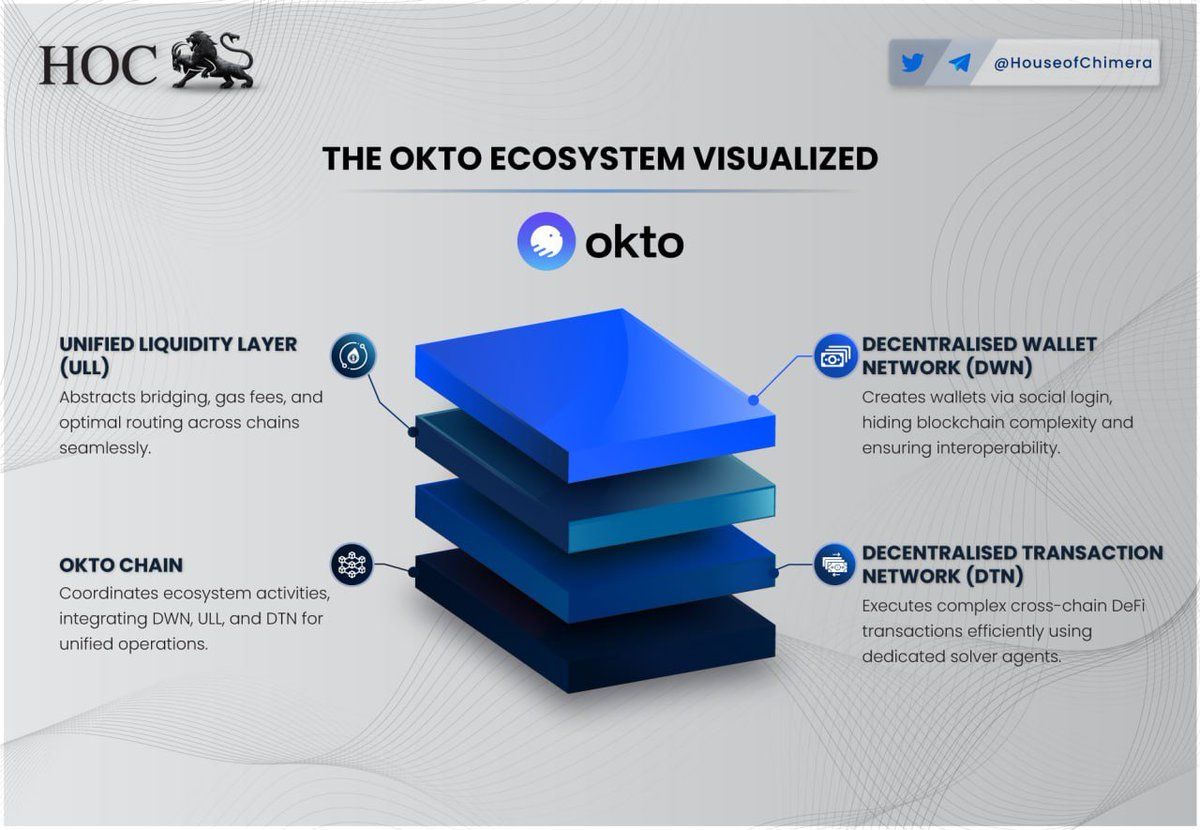
The latter aims to be the ‘Eureka’ or Lightbulb moment in the Web3 industry by streamlining the UX and DevEX. The @okto_web3 Platform consists of four layers, which work together to abstract all the complexities away from the user.
- Decentralised Wallet Network (DWN): Forget seed phrases. With Okto's Decentralized Wallet Network (DWN), onboarding is as easy as logging into your favorite Web2 app – using social logins like Google or email, all secured by cutting-edge Multi-Party Computation (MPC) behind the scenes. Say goodbye to wallet juggling. DWN delivers a universal wallet, working seamlessly across multiple chains and dApps – you won't notice the blockchain complexities fading away. The user can focus on what he wants to achieve without worrying about how to get there.
- Unified Liquidity Layer (ULL): Bridging? That’s old news as well. With ULL, users won’t realize they are bridging assets across chains. You no longer need to figure out how to find the best routes or worry about managing gas fees across different networks. Everything is abstracted away, making cross-chain swaps as seamless as native transactions. It starts to feel like a Web2 application, right anon?
- Decentralised Transaction Network (DTN): This is the engine that makes it all work. DTN takes center stage, handling all the heavy lifting required to fulfill user intents. Does the user want to perform complex cross-chain DeFi transactions? That's not an issue. A decentralized network of DTN nodes orchestrates the entire process and will ensure that the user’s intent gets executed most resource-efficiently by utilizing the ULL.
- Okto Chain: The heart of the Okto Platform, the Okto Chain isn't just another Layer 1 blockchain; it's a dedicated coordination layer. Typically, Layer 1s are general-purpose chains whereby users can create dApps through smart contracts; in Okto, this is slightly different. Its purpose is to coordinate all the activities across the Okto Ecosystem, including DWN, ULL, and DTN.
From Intent to Execution
Let’s assume a user wants to swap Wrapped Ethereum on Arbitrum for cbBTC on Ethereum. This is called the ‘intent’. The user expresses that intent, and the ULL will ensure it takes the most efficient route to swap the Wrapped Ethereum on Arbitrum for cbBTC on Ethereum. To ensure that every transaction is reliably executed and confirmed, DTN cuts the transaction into multiple sub-transactions, creates a payload, and gets it signed by DWN before execution.
After the swap, the cbBTC is put into a lending pool through the solvers. Last but not least, each sub-transaction that has occurred is being confirmed and monitored to ensure that there are no issues on both chains. If a sub-transaction fails, DTN automatically retries the logic or takes a different route to ensure the problem won’t happen again. If the intent is completed, the state of the Okto Chain will be updated; in other words, the DTN will log on to the Okto Chain that the intent is achieved.
But what about the Devs?
Web2 programming has evolved over many years into an ecosystem where reusable, modular components are second nature—much like snapping together Lego blocks to build complex structures. In contrast, Web3 is still in its developmental phase. While it does adopt modular strategies—for instance, using frameworks like OpenZeppelin to develop smart contracts or leveraging development tools such as Hardhat—the ecosystem isn’t yet as standardized or as effortlessly composable as that of Web2.
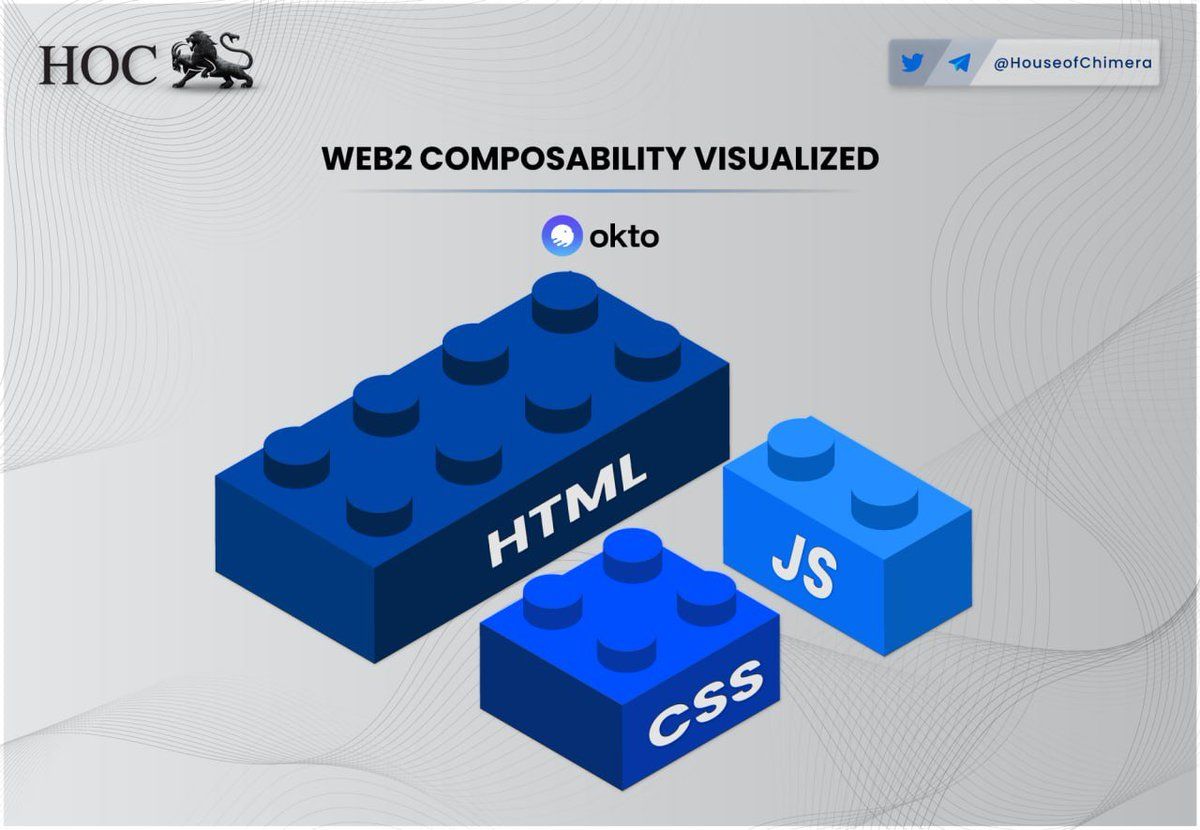
In Web3, modular building blocks face extra hurdles. Components must operate under strict immutability and security constraints, meaning cryptographic protocols and consensus mechanisms govern every piece. This can complicate assembling and reusing these components, making the “Lego block” metaphor less intuitive. Additionally, as Web3 standards are still emerging, developers often encounter compatibility issues and the need for frequent updates, further complicating the modular integration process.
Okto aims to make the developer experience closer to the Web2 experience through the Okto SDK V2, allowing developers to start using the Okto Tech Stack without technical entry barriers. Developers can instantly begin to experience the entire stack - DWN, ULL, DTN, and Okto Chain - and deliver on a friendly UX through abstract multi-chain experiences.
Ready to dive into the action, anon? Check out Okto's testnet to embrace the power of Chain Abstraction fully.
Make sure to visit:
- https://testnet.okto.tech/
- https://okto.tech/sdk to start building!