Quai Network’s Bold Solution to the Blockchain Trilemma
5 min
Published · Updated
Beginner
add FAQ
In this article
Explore how Quai Network tackles the blockchain trilemma with a hierarchical PoW model, fast finality, and innovative scalability.
Overview
Key takeaways
Quai uses a hierarchy of interconnected chains to distribute transaction processing across Prime, Region, and Zone layers.
Its Proof-of-Work model reuses mining effort across multiple chains through merged mining rather than replacing PoW with a new consensus family.
The design trades architectural simplicity for higher parallel capacity while still depending on miners and cross-chain coordination for security.
The blockchain space is evolving fast, but one issue continues to haunt Layer-1 designs: the Blockchain Trilemma, the near-impossible task of achieving scalability, decentralization, and security simultaneously. Despite years of innovation, no solution has decisively balanced all three. Enter Quai Network, a fresh Layer-1 contender that brings radical ideas to the table.
The Blockchain Trilemma: A Refresher
Vitalik Buterin, one of Ethereum’s co-founders, introduced the idea of the blockchain trilemma. This concept says blockchains can only truly excel at two out of three things: scalability, decentralization, and security. Take Bitcoin, for example. It’s highly secure and decentralized, but it comes at the cost of being slow and pricey. Conversely, Proof-of-Stake (PoS) networks tend to sacrifice some decentralization to boost speed and handle more transactions.
Quai is trying to take a different path.
The core trade-offs haven't disappeared even with new solutions like Layer-2 rollups and hybrid chains. Ethereum still sees high fees when things get busy. Solana is blazing fast but has raised concerns about how decentralized it is. The trilemma is still one of the major hurdles in blockchain development.
Quai Network's Architecture: Beyond Nakamoto
Quai uses a unique consensus model called Proof-of-Entropy-Minima (PoEM), which gives more “weight” to blocks based on how much entropy, or randomness, is reduced during mining (think of it like counting the number of leading zeros). The block with the most weight wins, which helps the network achieve near-instant finality. The idea is to confirm transactions quickly without giving up on security.
The network is built around a three-layer system:
Prime Chain: Acts as the backbone for global consensus and security, creating a new block every 15 minutes.
Region Chains: These collect headers from multiple Zones and allow transactions between Zones in the same region, with blocks every 5 minutes.
Zone Chains: These are the fast lanes—EVM-compatible environments that confirm transactions in about 7 to 10 seconds.
Thanks to this setup, Quai can scale horizontally without running into traffic jams. They claim the system can handle up to 50,000 transactions per second. And as demand grows, new Zones or subnetworks can spin up automatically, helping keep things fast and cheap.
A Different Spin on PoW
Most Proof-of-Work blockchains use a lot of energy and aren’t exactly quick to scale. Quai takes a smarter route with merged mining via ProgPoW, letting miners secure all network layers: Prime, Region, and Zone Chains at once. This means Quai can scale its security much faster by tapping into existing mining infrastructure without needing extra hardware or computing power.
To keep miners engaged, Quai also uses a deflationary token model paired with a dual-token setup:
QUAI is the main account-based token, used for gas fees, smart contracts, and decentralized apps.
QI is a UTXO-based, privacy-focused coin designed for simple, cash-like payments using fixed denominations.
Miners can pick whether to earn QI or QUAI, or even lock their rewards to boost returns by up to 25%. The whole system is designed to grow securely, run efficiently, and reward long-term participation.
Technical Innovations and Developer UX
Quai’s design isn’t just theory; it’s built to solve real problems. Access lists allow the network to run transactions in parallel without risking conflicts. Each transaction lists the accounts and storage slots it will touch, so nodes can safely process unrelated transactions simultaneously. This helps cut down on bottlenecks while keeping the system stable.
In addition, Quai works smoothly with familiar Ethereum tools like Hardhat, Foundry, and OpenZeppelin. That means developers can easily migrate their dApps without much extra effort. With its self-hosted RPC setup, Quai stays flexible while giving developers solid control over how they connect to the network.
Competitive Landscape: Where Quai Fits
At House of Chimera, we see Quai carving out a unique position in a space dominated by PoS chains. It offers a high-throughput, privacy-aware, and energy-efficient Proof-of-Work alternative that stands apart from typical EVM forks. Some of the standout features include:
Stronger economic finality, making chain reorganizations more expensive.
Native on-chain checkpoints through coincident blocks.
A scalable design that expands based on network load.
Still, strong architecture alone won't be enough in a crowded market full of forks and short-term airdrop chasers. For Quai to truly break through, it’ll need real adoption, engaging apps, sticky incentives, and a story that resonates.
The Bigger Picture
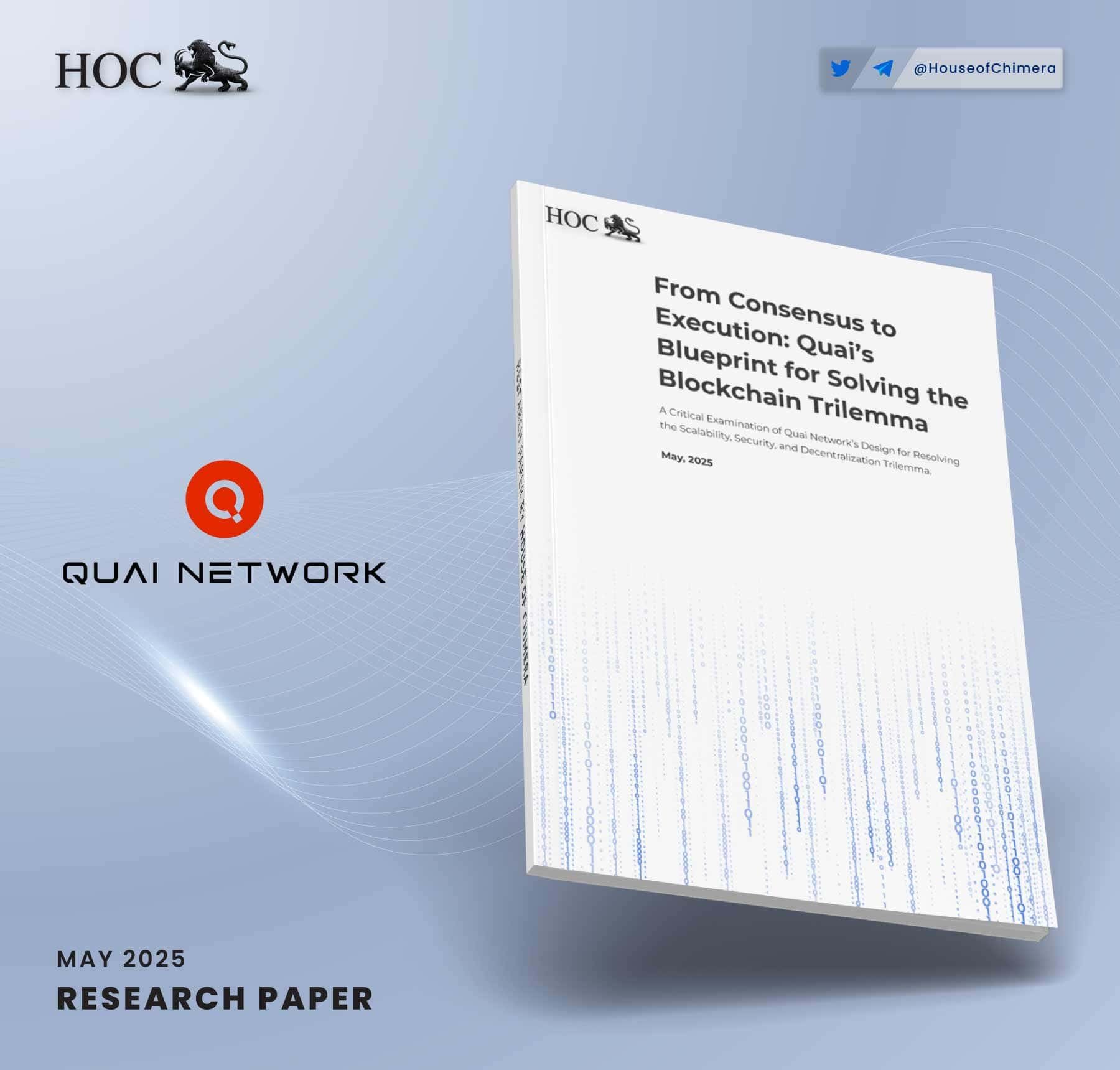
To understand Quai's full design philosophy, economic model, and competitive positioning, read the full research paper. It offers detailed insights into how Quai aims to redefine what Layer-1 blockchains can be.
Frequently asked questions
What is the blockchain trilemma?
The blockchain trilemma describes the difficulty of maximizing scalability, decentralization, and security at the same time.
How does Quai Network try to scale Proof of Work?
Quai distributes activity across a hierarchy of interconnected chains and uses merged mining so the same mining work can contribute to multiple chains.
Is Quai Network a Layer 1?
Yes. Quai is designed as a Layer 1 network with its own consensus and multi-chain architecture rather than as a Layer 2 on Ethereum.
Related insights