In this report · 7 sections
Overview
Key takeaways
Global growth is holding at 3.1%, but only 32 countries now produce 95% of it, down from 54 in April, as AI hardware exporters accelerate and energy importers slow.
Energy-driven inflation is pushing the Fed, the European Central Bank, and the Bank of Japan to raise rates while China holds, but the Fed moved three months after its peers and is now following the data rather than leading it.
The war, fiscal deficits, and the AI build-out are arriving as higher borrowing costs, while central banks rotate from U.S. Treasuries into gold and stablecoin supply contracts.
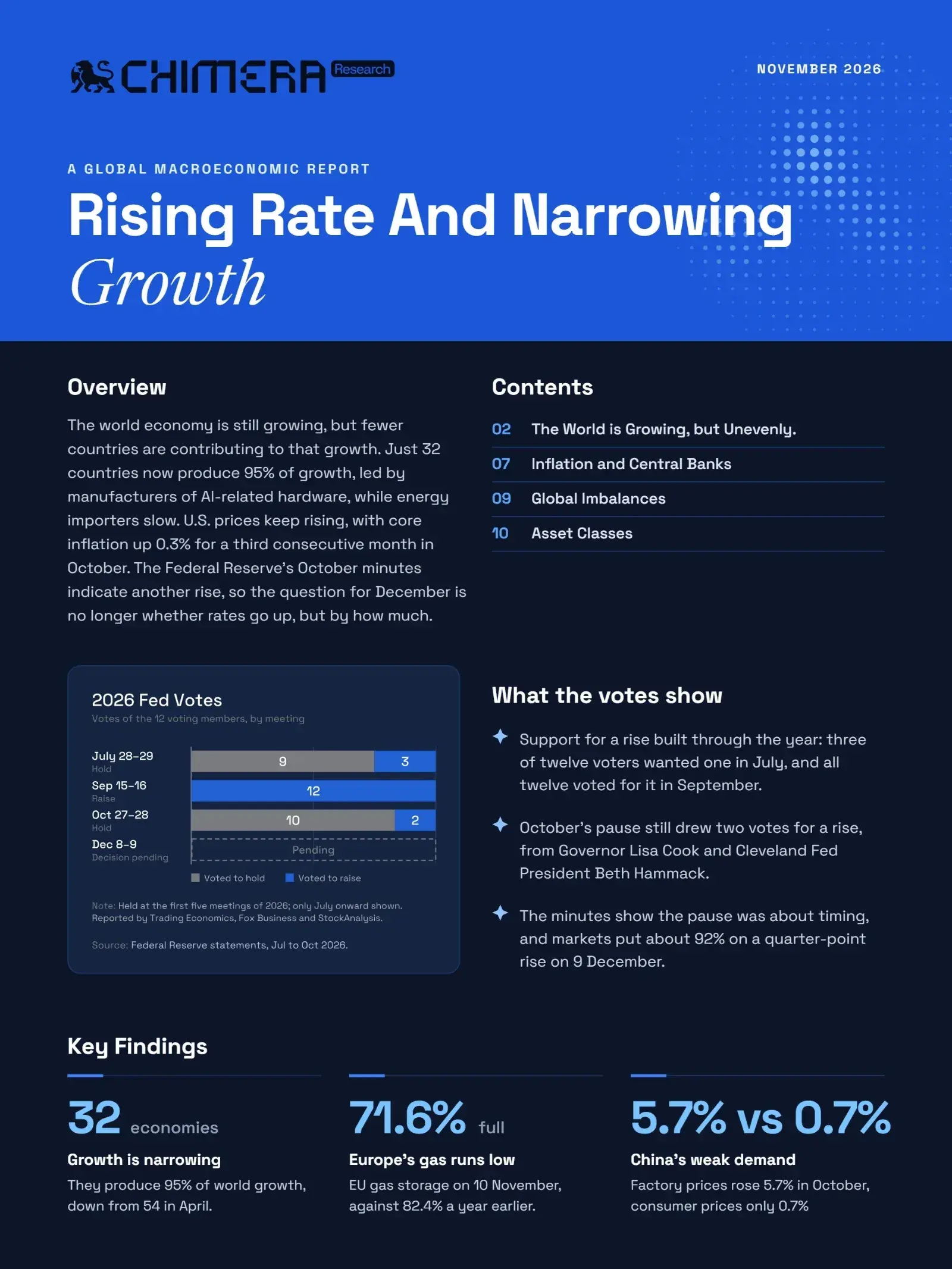
The war in the Middle East has choked Gulf energy exports through the Strait of Hormuz, while spending on AI hardware has concentrated growth in a small group of chip-producing nations. The headline numbers remain calm, but the base beneath them has narrowed, and the major central banks, with the exception of China, are tightening again. This article highlights the key findings of our November 2026 Global Macroeconomic Report, which covers each region and asset class in depth across 22 figures.
The World Is Growing, but Unevenly
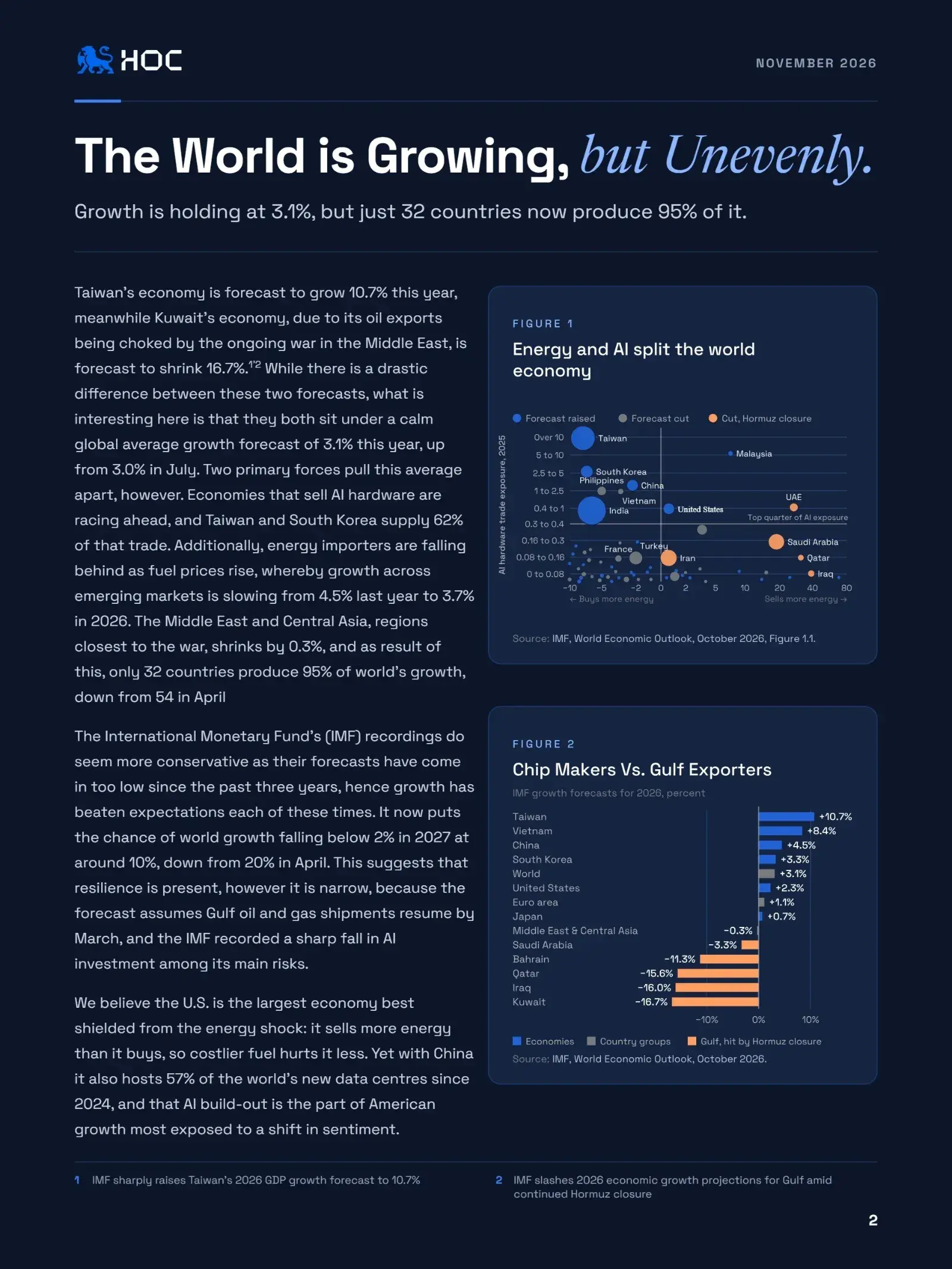
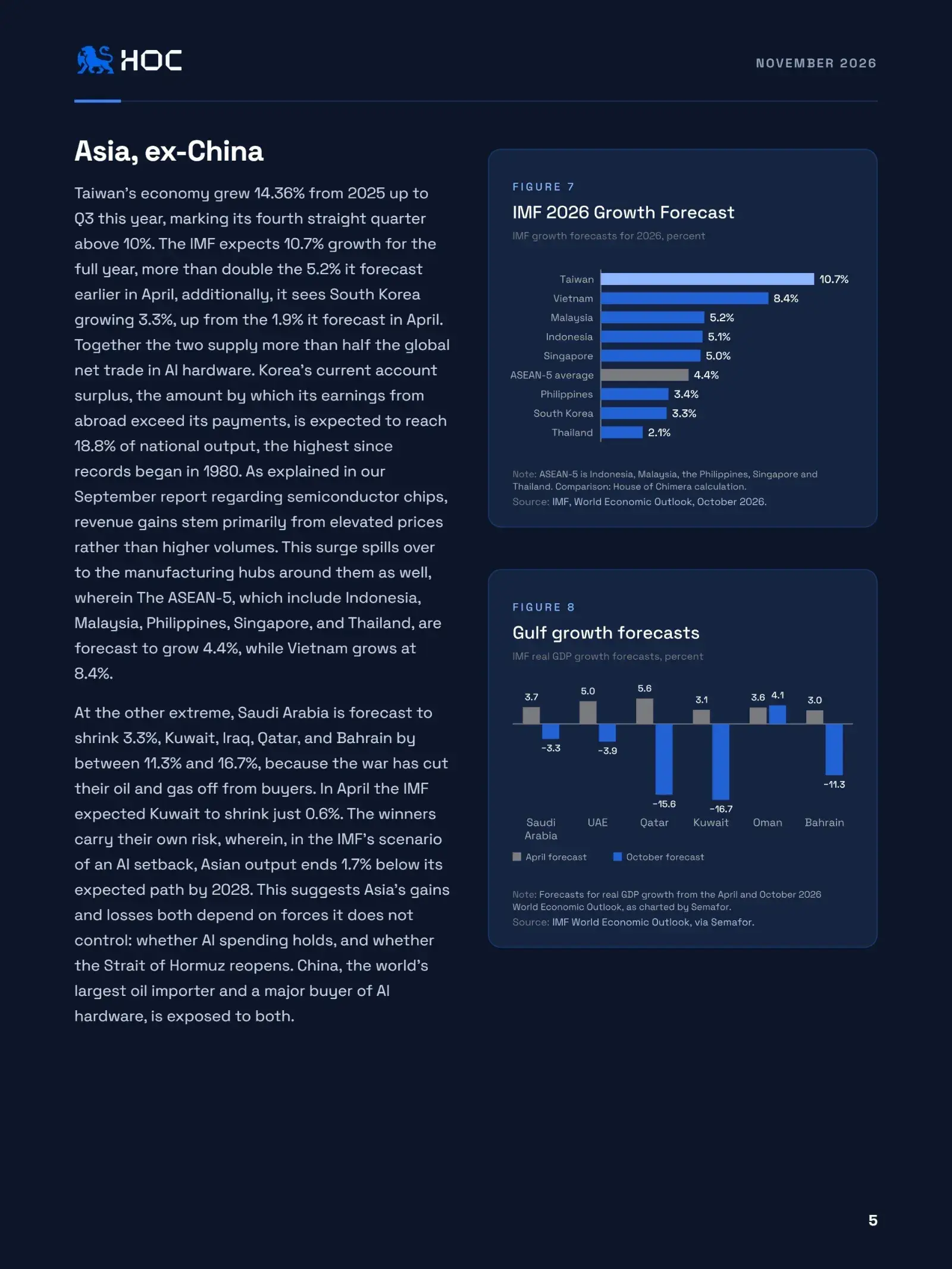
Global growth is forecast at 3.1% this year, but only 32 countries now produce 95% of it, down from 54 in April. Economies that sell AI hardware are racing ahead, with Taiwan forecast to grow 10.7%, while Kuwait is forecast to shrink 16.7% as the war cuts its oil off from buyers.
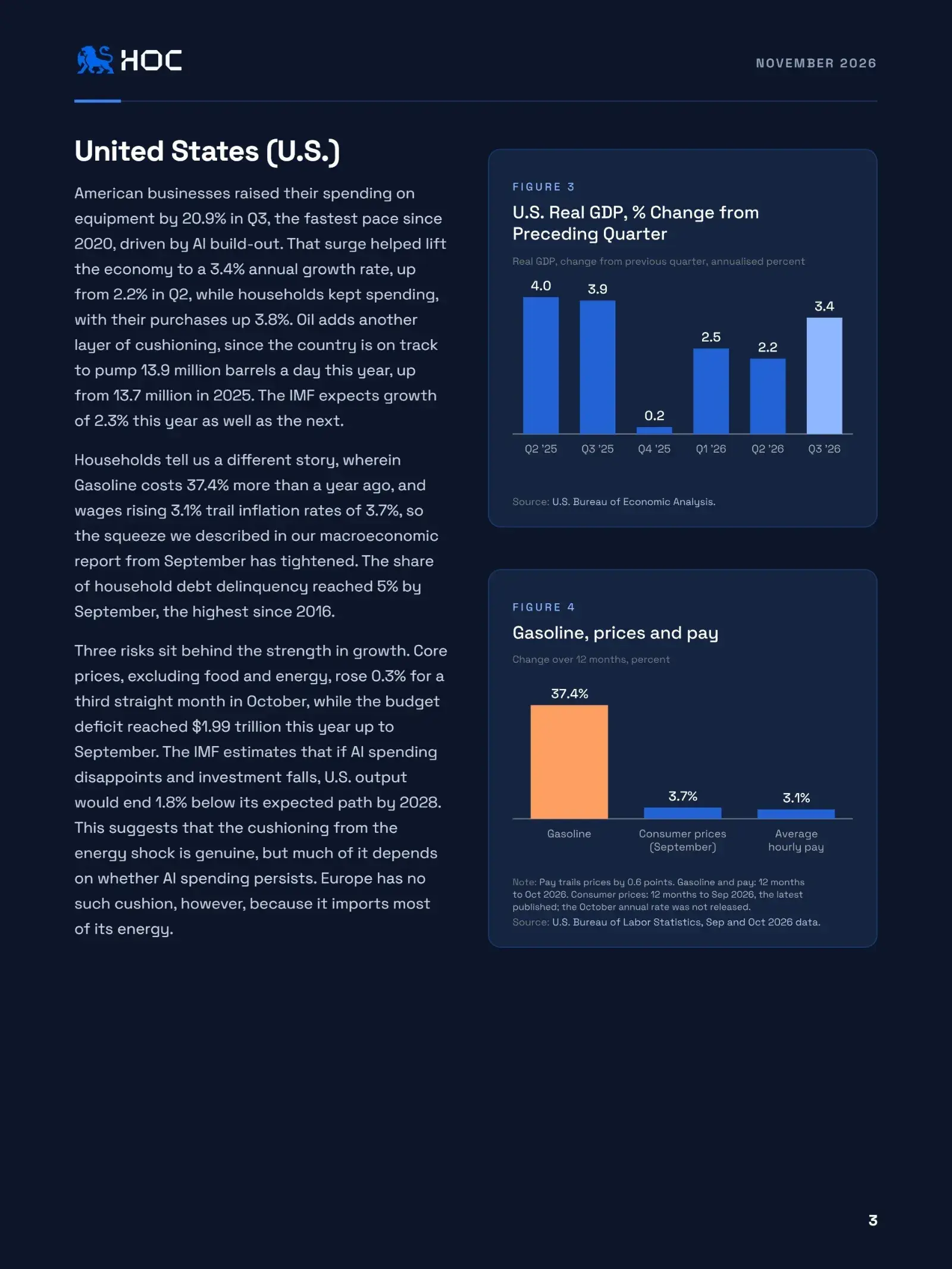
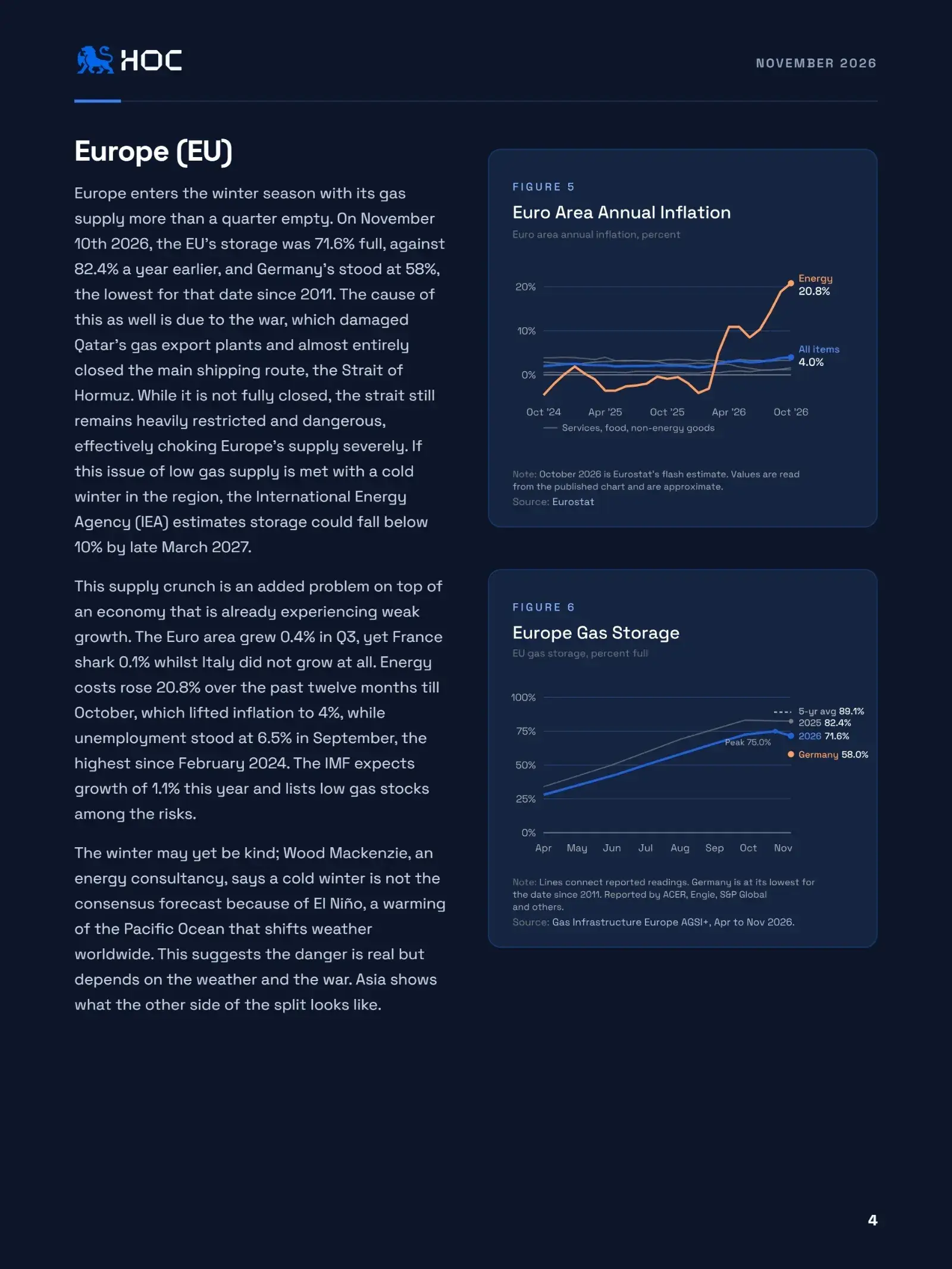
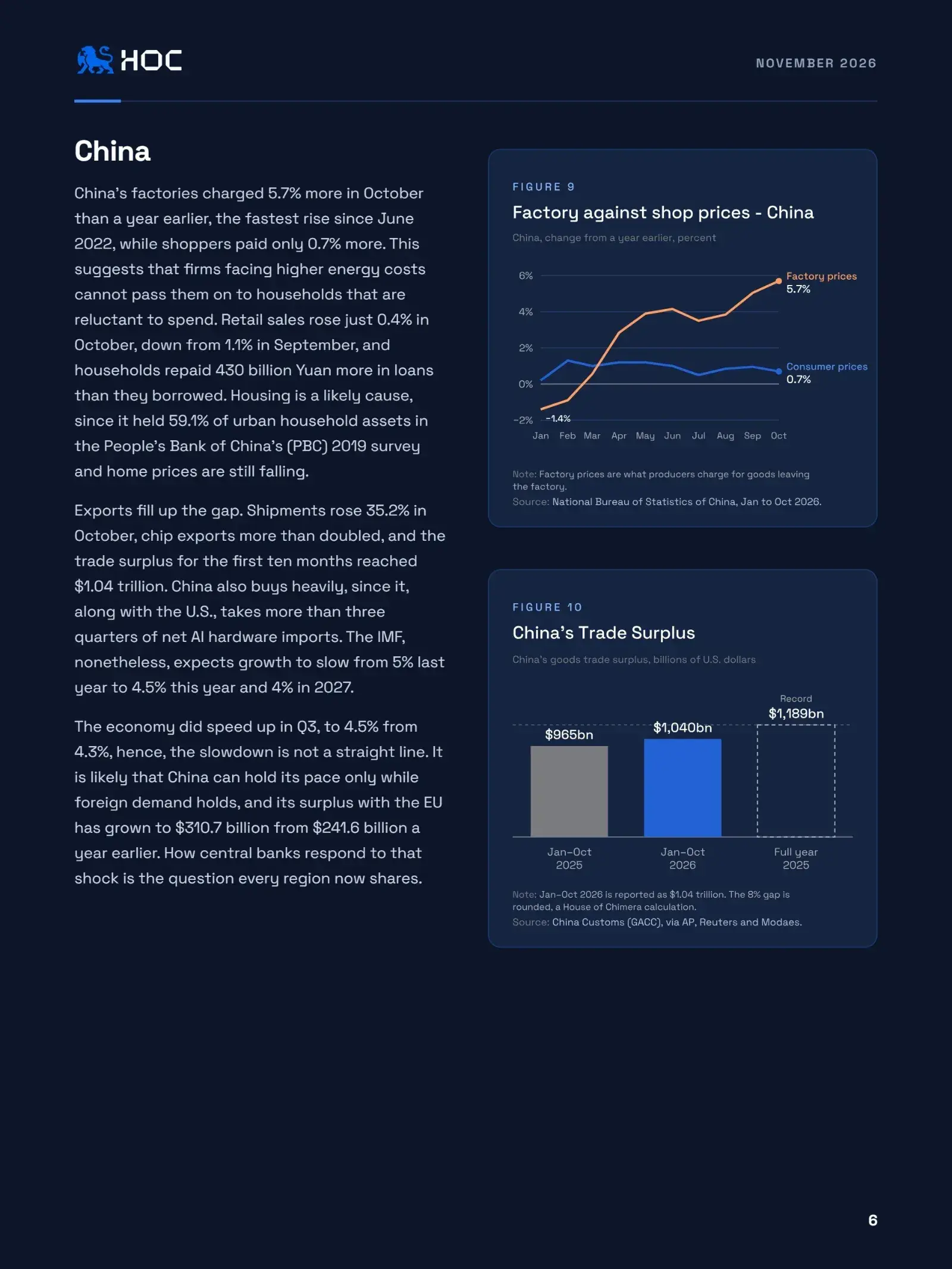
The energy shock is landing unevenly. The U.S. sells more energy than it buys and is cushioned by an AI investment boom, yet households face gasoline prices 37.4% higher than a year ago. Europe enters winter with gas storage at 71.6%, down from 82.4% a year earlier, and China’s factory prices are rising 5.7% while consumer prices are rising only 0.7%.
Chip Makers Vs. Gulf Exporters
Show the numbers
| Country / Group | 2026 growth forecast | Category |
|---|---|---|
| Taiwan | 10.7% | Economy |
| Vietnam | 8.4% | Economy |
| China | 4.5% | Economy |
| S. Korea | 3.3% | Economy |
| World | 3.1% | Country group |
| United States | 2.3% | Economy |
| Euro | 1.1% | Country group |
| Japan | 0.7% | Economy |
| Saudi Arabia | -3.3% | Gulf (hit by Hormuz closure) |
| Bahrain | -11.3% | Gulf (hit by Hormuz closure) |
| Qatar | -15.6% | Gulf (hit by Hormuz closure) |
| Iraq | -16% | Gulf (hit by Hormuz closure) |
| Kuwait | -16.7% | Gulf (hit by Hormuz closure |
Embed or cite
Free to reuse under CC BY 4.0: credit Chimera Labs and link to this chart.
Embed code
<iframe src="https://www.houseofchimera.com/embed/charts/chip-makers-vs-gulf-exporters" title="Chip Makers Vs. Gulf Exporters" width="100%" height="420" style="border:0" loading="lazy"></iframe>
<p>Chart: <a href="https://www.houseofchimera.com/labs/research/fed-following-the-data-november-2026-macro#chart-chip-makers-vs-gulf-exporters">Chip Makers Vs. Gulf Exporters</a> by Chimera Labs, House of Chimera (<a href="https://creativecommons.org/licenses/by/4.0/">CC BY 4.0</a>)</p>Citation
Chimera Labs (2026). "Chip Makers Vs. Gulf Exporters" [chart], data as of 18 Nov 2026. House of Chimera. https://www.houseofchimera.com/labs/research/fed-following-the-data-november-2026-macro#chart-chip-makers-vs-gulf-exporters
The full report breaks down the U.S., Europe, Asia, and China region by region, including the IMF's AI setback scenario and Europe's winter gas outlook.
The Fed Is Following the Data, Not Leading It
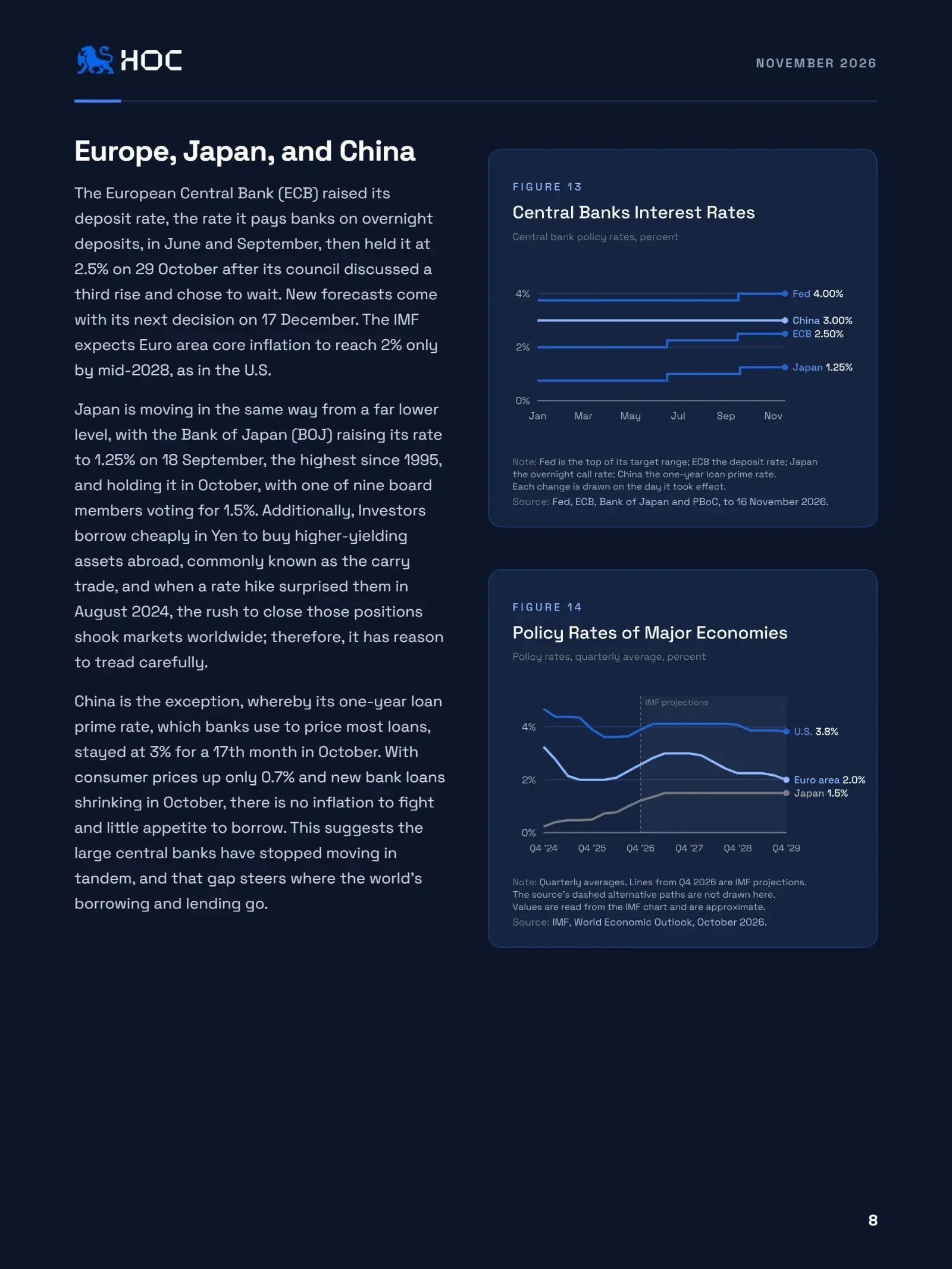
The ECB and the Bank of Japan both raised rates in June. The Fed waited until 16 September, raising its policy rate to a range of 3.75% to 4%, then paused in October by ten votes to two. Since then, the data have outrun that caution: employers added 165,000 jobs in October against a forecast of 65,000, producer prices rose 6.5% year on year, and core prices rose 0.3% for a third consecutive month.
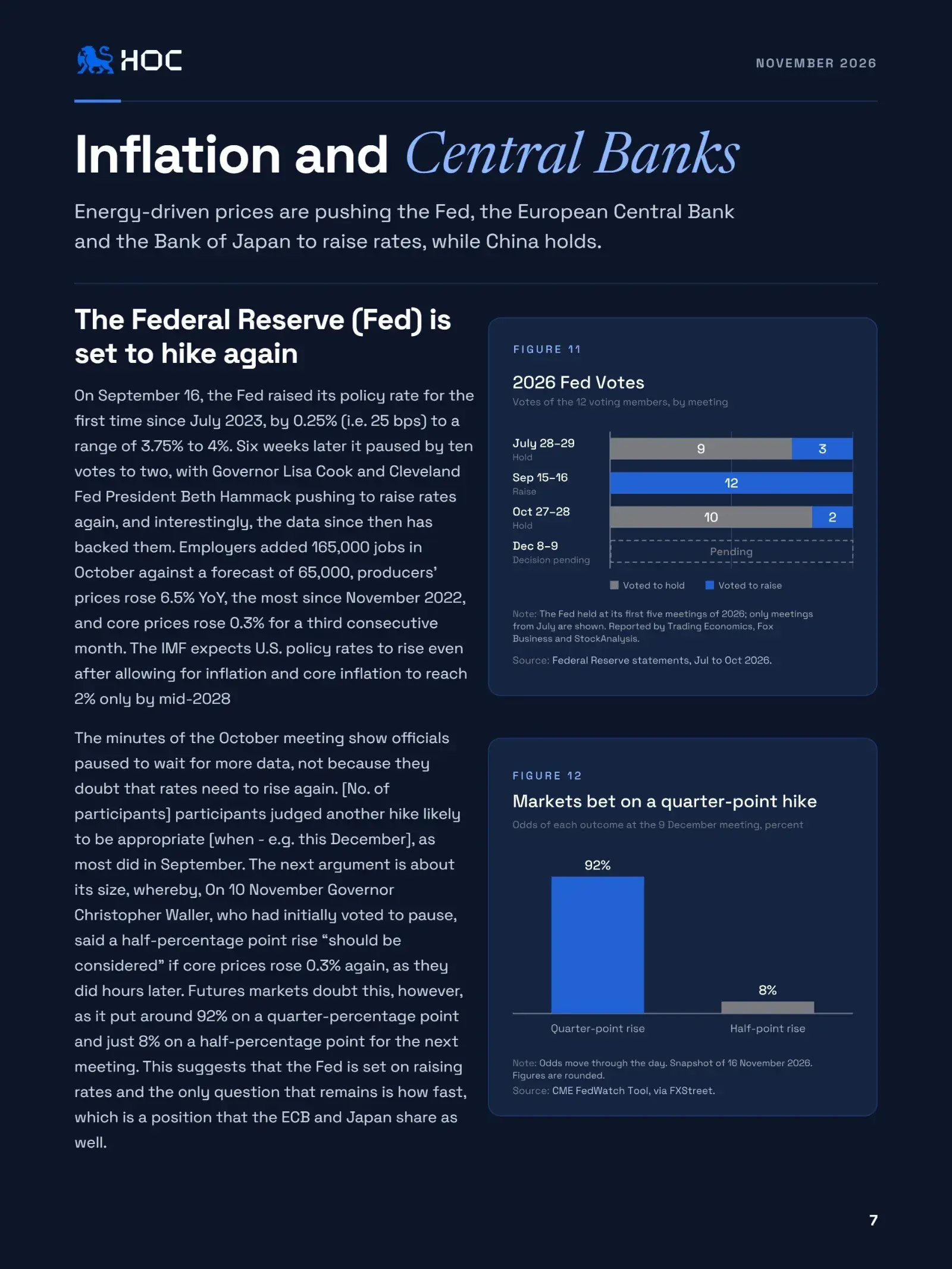
Futures markets now treat a December rise as certain, with about 8% on a half point. This suggests a Fed that follows the data rather than leads it, which raises the risk of faster rises later.
Markets now treat a December Fed rise as certain
Show the numbers
| outcome | probability % |
|---|---|
| Quarter-point rise | 92.1% |
| Half-point rise | 7.9% |
Embed or cite
Free to reuse under CC BY 4.0: credit Chimera Labs and link to this chart.
Embed code
<iframe src="https://www.houseofchimera.com/embed/charts/markets-now-treat-a-december-fed-rise-as-certain" title="Markets now treat a December Fed rise as certain" width="100%" height="420" style="border:0" loading="lazy"></iframe>
<p>Chart: <a href="https://www.houseofchimera.com/labs/research/fed-following-the-data-november-2026-macro#chart-markets-now-treat-a-december-fed-rise-as-certain">Markets now treat a December Fed rise as certain</a> by Chimera Labs, House of Chimera (<a href="https://creativecommons.org/licenses/by/4.0/">CC BY 4.0</a>)</p>Citation
Chimera Labs (2026). "Markets now treat a December Fed rise as certain" [chart], data as of 18 Nov 2026. House of Chimera. https://www.houseofchimera.com/labs/research/fed-following-the-data-november-2026-macro#chart-markets-now-treat-a-december-fed-rise-as-certain
The full report covers the October minutes, the vote-by-vote record, and where the ECB, the Bank of Japan and the People's Bank of China stand.
Who Pays for America's Surge
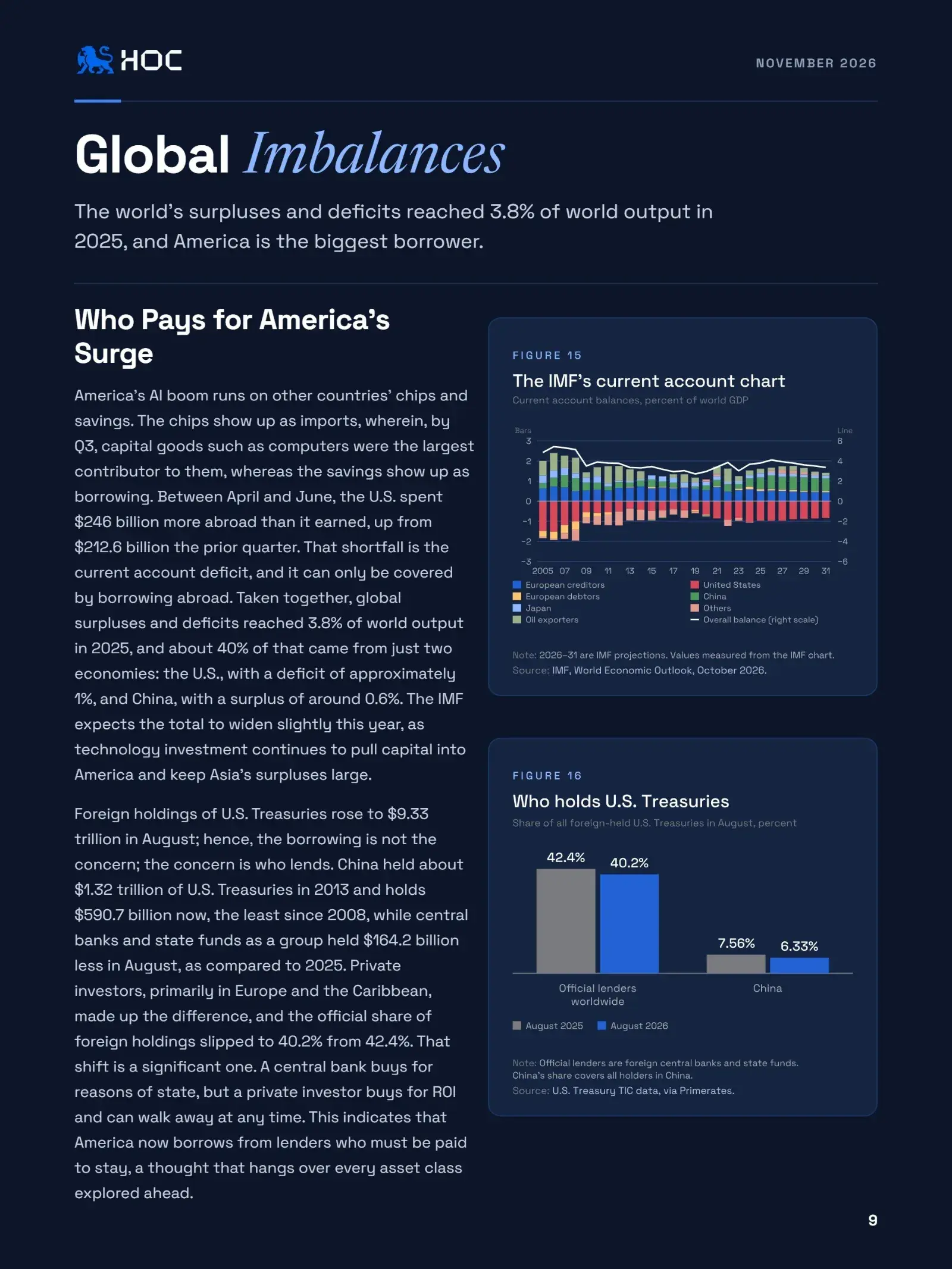
America's AI boom runs on other countries' chips and savings, and the U.S. spent $246 billion more abroad than it earned between April and June. The lenders are changing. Foreign central banks and state funds now hold 40.2% of foreign-held Treasuries, down from 42.4% a year earlier, and China's holdings have fallen to $590.7 billion, the least since 2008. America now borrows from lenders who must be paid to stay.
Asset Classes
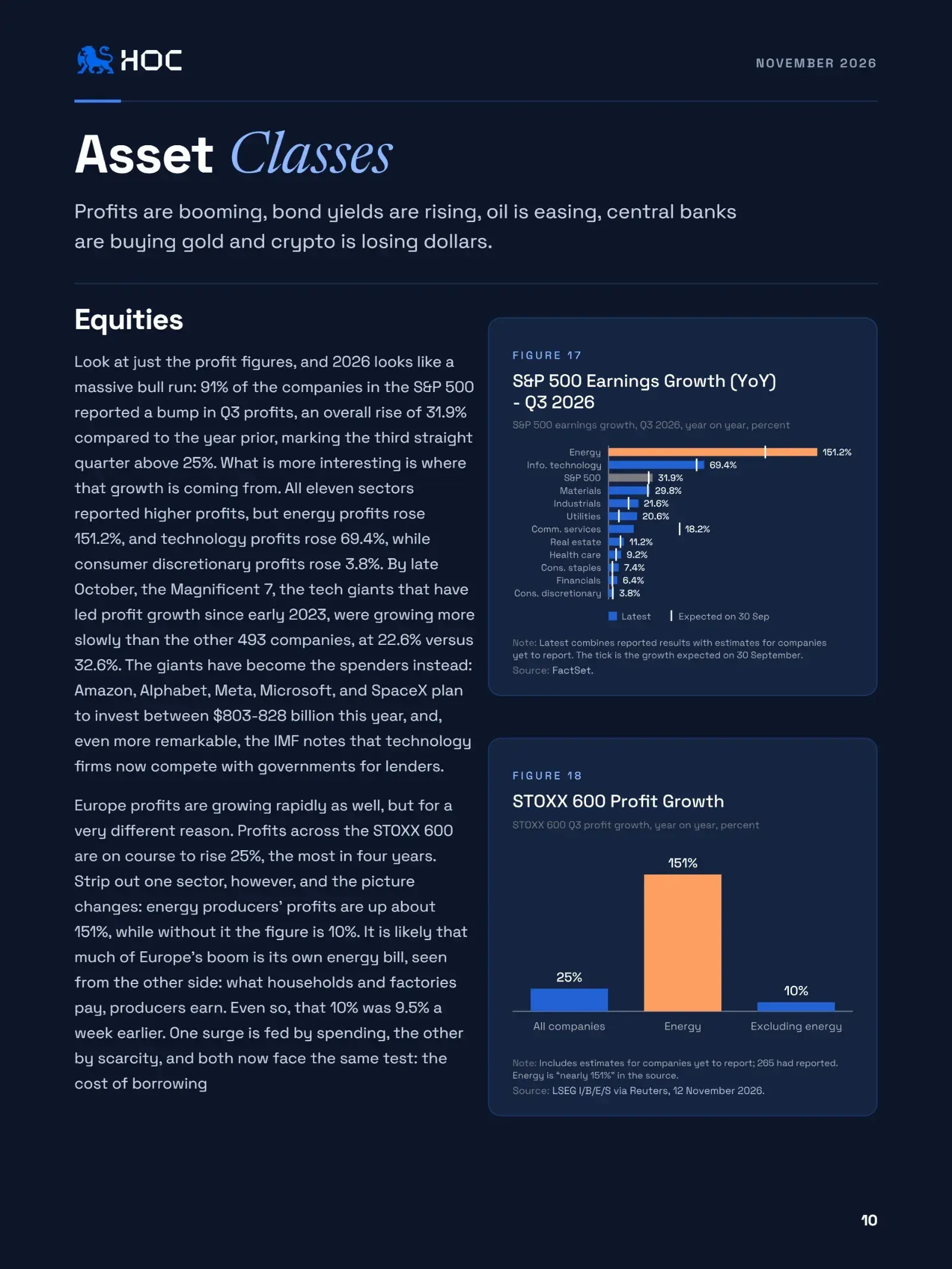
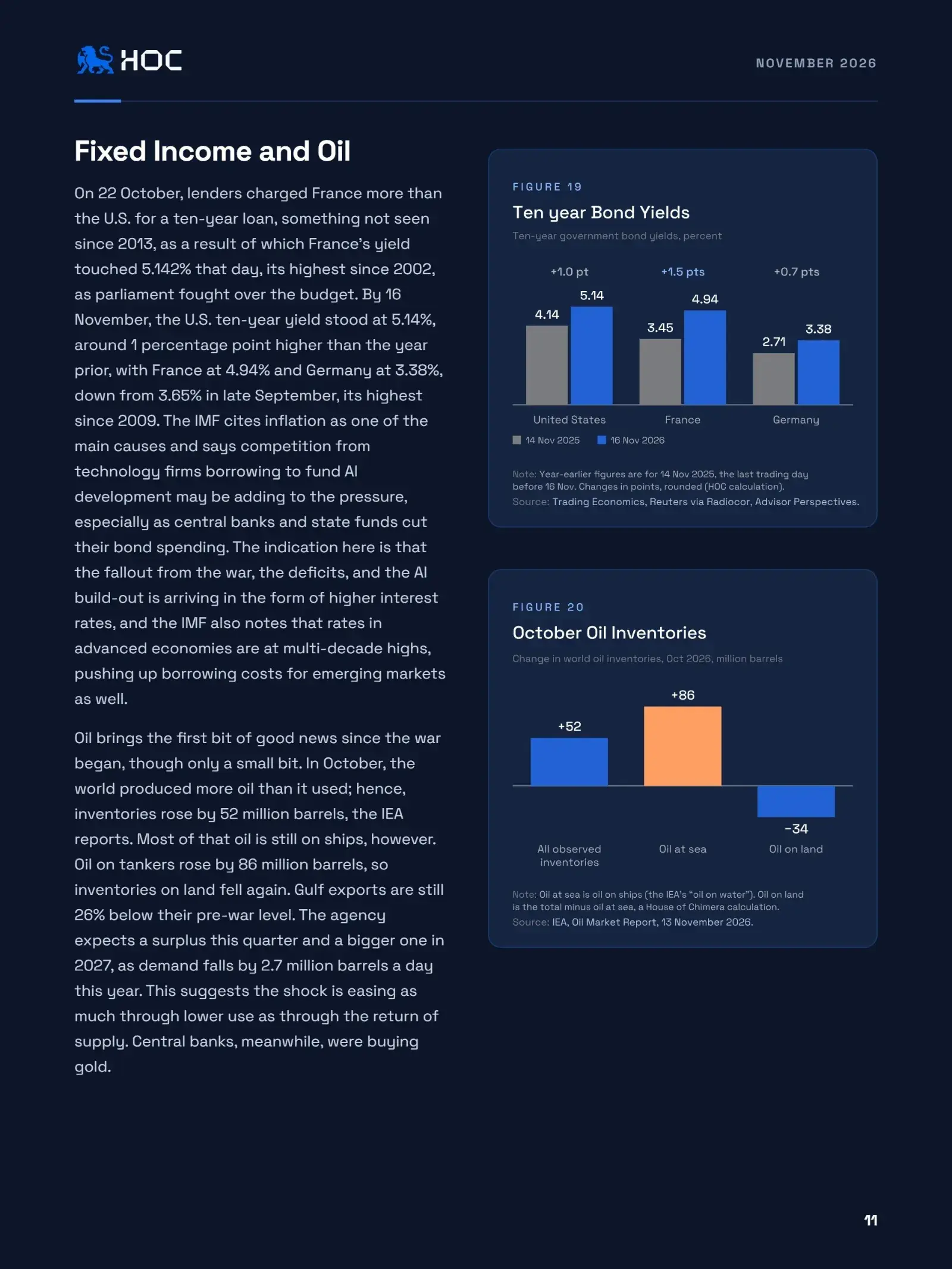
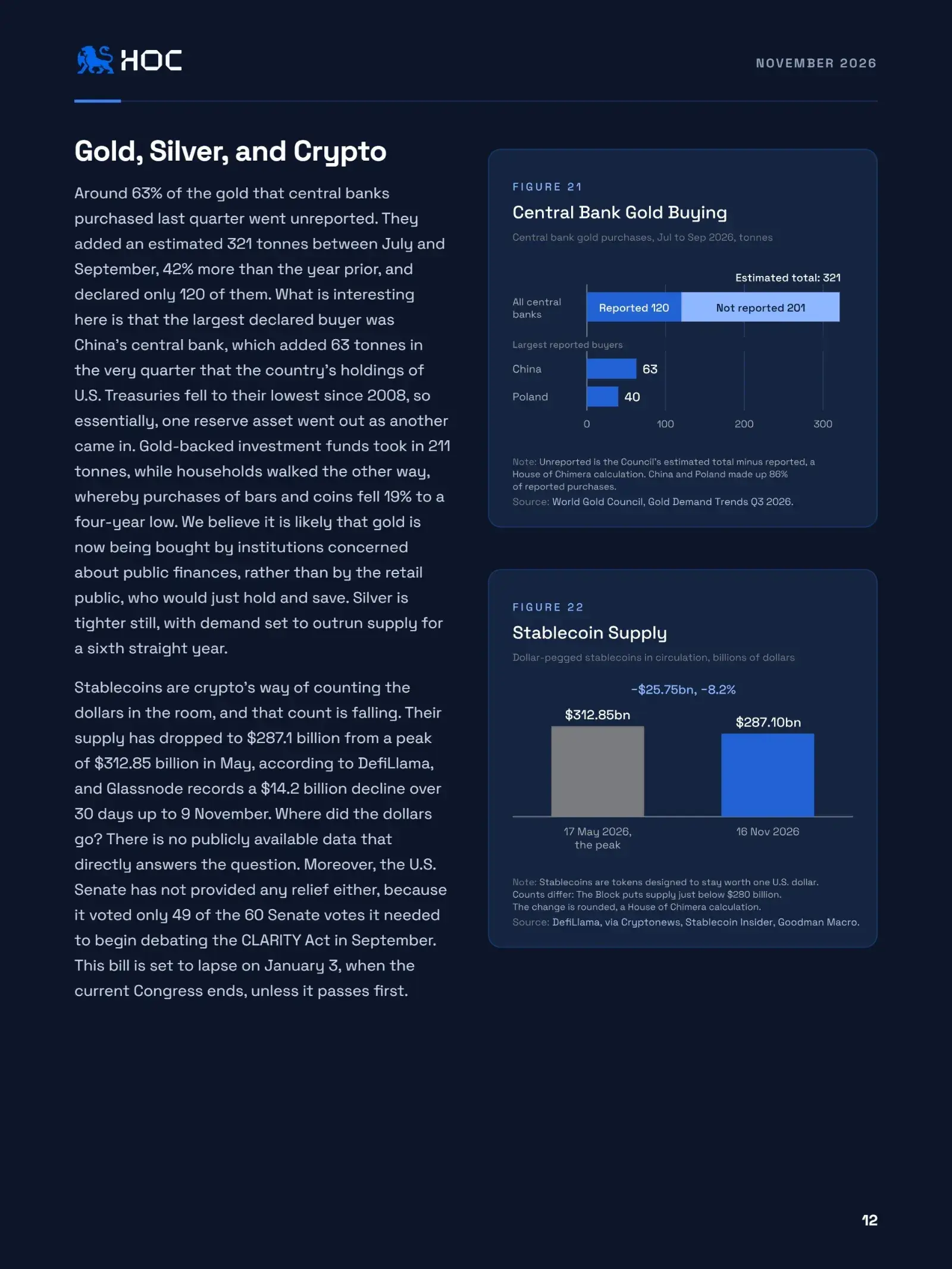
Higher rates are now visible across markets. The U.S. ten-year yield stood at 5.14% on 16 November, about one percentage point higher than a year earlier. Central banks bought an estimated 321 tonnes of gold in Q3, around 63% of it unreported, and stablecoin supply has fallen 8.2% from its May peak to $287.1 billion, a sign of fewer dollars circulating in crypto markets.
The full report also covers S&P 500 and STOXX 600 earnings, the oil inventory build, and the outlook for the CLARITY Act.
Conclusion
The world economy is resilient in aggregate but narrow beneath the surface, and its durability hinges on whether AI spending holds and whether the Strait of Hormuz reopens. With the Fed reacting to each new data release after a late start, the risk is that borrowing costs rise faster than markets expect.
Read the full November 2026 Global Macroeconomic Report for all 22 figures and the complete regional and asset class analysis.
Frequently asked questions
What does the House of Chimera November 2026 Global Macroeconomic Report cover?
The report covers four areas: the distribution of global growth, inflation and central bank policy, global imbalances, and asset classes including equities, bonds, oil, gold and crypto. It draws on IMF, central bank, government and market data across 22 figures.
Why do you say the Fed is following the data rather than leading it?
The Fed paused in October to wait for more evidence, but the data that followed (165,000 new jobs, producer prices up 6.5% and a third straight 0.3% rise in core prices) moved faster than its caution. Markets now treat a December rise as certain, so the Fed is responding to each release rather than setting the path.
How far behind other central banks is the Fed?
The ECB and the Bank of Japan both raised rates in June, three months before the Fed's first rise on 16 September. A late start raises the risk that the Fed has to move faster later to catch up with inflation.
Will the Fed raise rates by a quarter or a half point in December?
As of 16 November, futures markets priced no chance of an unchanged rate at the 9 December meeting, about 92% on a quarter-point rise and 8% on a half point. Governor Christopher Waller has said a half-point rise should be considered.
Why is global growth described as narrowing?
Global growth is holding at 3.1%, but only 32 countries now produce 95% of it, down from 54 in April. AI hardware exporters such as Taiwan and South Korea are accelerating, while energy importers and Gulf exporters cut off by the war are slowing or shrinking.
How exposed is Europe to a gas shortage this winter?
EU gas storage was 71.6% full on 10 November, against 82.4% a year earlier, and Germany's was 58%, the lowest for that date since 2011. The IEA estimates a cold winter could push EU storage below 10% by late March 2027, although a cold winter is not the consensus forecast.
Why does it matter who holds U.S. Treasuries?
Foreign central banks and state funds are cutting their holdings, and private investors are filling the gap. Official lenders buy for strategic reasons, whereas private investors buy for return and can leave at any time, which means the U.S. must pay more to keep borrowing.