What is Stacks? The Bitcoin Layer 2 unlocking native $BTC yield
10 min
Published · Updated
Beginner
Add FAQ
In this article
Stacks' proposed PoX-5 upgrade lets Bitcoin holders earn native, self-custodial $BTC yield by pairing $BTC with a small $STX bond. An eight-year model is funded every cycle, but sustainability hinges on the $STX price.
Overview
Key takeaways
Stacks PoX-5 lets $BTC holders earn native, self-custodial Bitcoin yield by pairing $BTC with a small $STX eligibility bond.
The eight-year model funded every cycle across bear, base, and bull scenarios because capacity controls capped obligations below miner-funded revenue.
Sustainability hinges entirely on the $STX price; a sudden 70% crash drained the bear-case reserve to roughly 0.4 years of coverage.
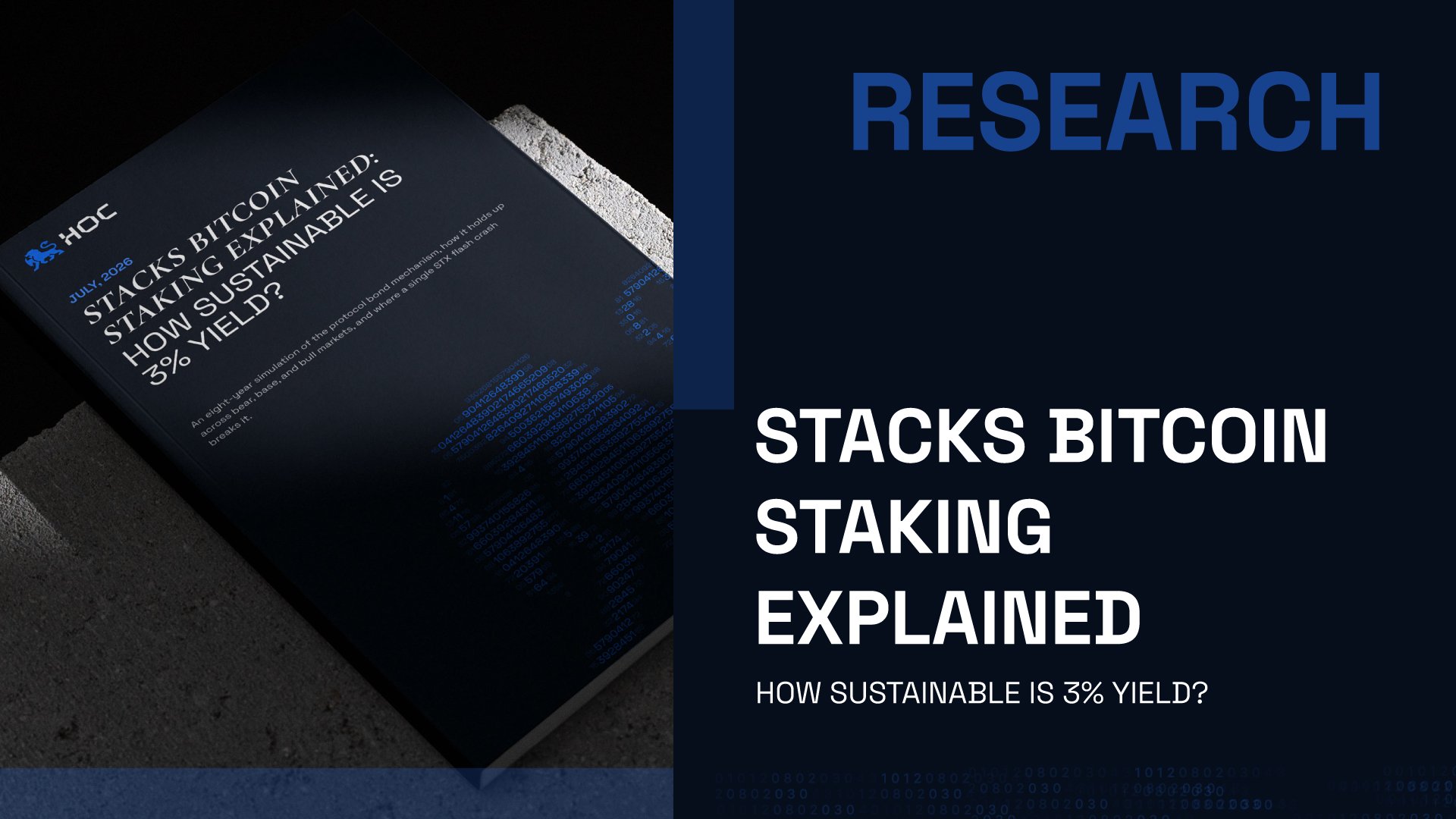
Bitcoin has no native staking mechanism, so holders seeking yield have traditionally relied on wrapped assets, bridges, centralized custodians, or lending platforms that introduce additional custody, smart contract, and counterparty exposure. The proposed Stacks Bitcoin Staking design would allow participants to earn $BTC-denominated rewards while keeping native $BTC under a self-custodial Layer 1 timelock. The yield would continue to come from $BTC committed by miners through Proof-of-Transfer rather than lending activity or newly issued Bitcoin. An eight-year simulation found that the published design funded every baseline cycle across bear, base, and bull scenarios because capacity controls kept modeled obligations within the miner-funded reward pool. Sustainability remains dependent on $STX price behavior, as a severe decline can reduce miner bidding, shrink the reward pool, and leave the reserve with limited protection after the first major shock.
WHAT IS STACKS AND HOW PROOF-OF-TRANSFER WORKS
Stacks is a Bitcoin Layer 2 that supports smart contracts and decentralized applications while recording its chain state on Bitcoin. Following the Nakamoto upgrade, miners can produce multiple Stacks blocks within a Bitcoin-linked tenure, after which the resulting chain state is committed to Bitcoin. Stacks still relies on its own miners and signer set to produce and approve blocks. Bitcoin provides the settlement layer for chain commitments rather than directly validating every Stacks transaction.
The network uses Proof-of-Transfer, or PoX, as its consensus mechanism. Instead of expending computational power or staking the network’s own token, miners commit $BTC to compete for the right to produce Stacks blocks. A bid-weighted selection process determines the next block producer. Larger $BTC commitments increase a miner’s probability of winning, although the highest bidder is not automatically selected. The winning miner receives newly issued $STX alongside transaction fees.
Most $BTC committed by miners is distributed to eligible Stacking participants, creating an economic exchange in which miners spend $BTC to acquire $STX block rewards while $STX holders lock their tokens and receive $BTC. The mechanism therefore supports network consensus and the distribution of Bitcoin-denominated rewards. As of July 9, 2026, the Stacks Bitcoin Staking page displayed approximately $494.14M in total value locked across $STX and $BTC and reported that Proof-of-Transfer had distributed 4,224 $BTC since launching in January 2021.
HOW STACKING GENERATES $BTC YIELD
Stacking is the existing process through which $STX holders receive $BTC rewards. Participants lock $STX for periods organized around two-week reward cycles and receive a proportional share of the $BTC committed by miners during each cycle. At the snapshot used in the research, approximately 581.42M $STX was actively stacked and the displayed reward APY was 7.17%. The available yield is bounded by miner economics because rational miners are unlikely to commit more $BTC than the expected value of the $STX block rewards and transaction fees they may receive. The size of the reward pool therefore depends on the $STX issuance schedule, the market value of $STX, transaction activity, and competition among miners.
A higher $STX price increases the economic value of the block reward and gives miners more room to commit $BTC. A sustained decline reduces the value miners expect to receive and can cause marginal operators to lower their bids or leave the market. The dependence on $STX miner economics becomes more consequential under Bitcoin Staking because the upgrade introduces additional $BTC-denominated obligations without creating a separate source of revenue.
WHAT THE BITCOIN STAKING UPGRADE WOULD CHANGE
The current PoX system distributes $BTC rewards to participants who lock $STX. Bitcoin holders cannot earn through the mechanism unless they first acquire and stack the network’s native token. The proposed PoX-5 upgrade would introduce a protocol bond that pairs $BTC with a smaller $STX commitment. The bond would qualify participants for $BTC rewards funded by miner commitments while allowing native $BTC principal to remain under the holder’s keys.
HOW THE PROTOCOL BOND WORKS
Participants could use native $BTC held in a self-custodial Bitcoin Layer 1 timelock or s$BTC held on Stacks. Both routes would qualify for the same protocol bond, although the s$BTC route retains the trust assumptions associated with the Stacks signer set. The protocol bond runs for approximately six months, equivalent to 25,200 Bitcoin blocks. The timing gap gives participants a window to renew or withdraw their $BTC before the $STX position unlocks. Under the native $BTC route, the principal remains under the participant’s keys and cannot be transferred before the timelock expires unless the optional co-signed early-exit mechanism is used.
The design removes the need to bridge the principal or transfer it to a centralized custodian. The paired $STX functions as an eligibility bond rather than a yield-bearing asset. It remains locked throughout the bonding period and does not earn a separate return. The proposed launch configuration includes 3,000 $BTC of capacity, a minimum $STX commitment equal to 5% of the $BTC position’s value, and a target $BTC yield of 3% annually, equivalent to approximately 1.44% across the six-month term. A participant locking $100,000 of $BTC would therefore need to acquire and lock approximately $5,000 of $STX alongside it.
CAPACITY AND YIELD DISTRIBUTION
The existing miner-funded reward pool would remain the sole source of Bitcoin Staking yield. Miners would continue committing $BTC to compete for $STX block rewards, while the $BTC collected through PoX would fund payments to eligible participants. Protocol bonds combining $BTC and $STX would form the first tranche of obligations and receive payment priority. Any rewards remaining after those obligations are met would be divided between $STX-only stackers and the protocol reserve, with 85% distributed to stackers and 15% added to the reserve.
The coverage ratio measures the miner-funded reward pool relative to total protocol bond obligations. A ratio of 1.0x indicates that current miner revenue can meet all required payments without reserve support. The whitepaper targets a 2.0x coverage ratio for capacity sizing, with an acceptable governance range of 1.5x to 3.0x. A 2.0x ratio means that new enrollment is limited to approximately half of the theoretical capacity supported by the available reward pool.
During the PoX-5 bootstrap, the Stacks Endowment would set capacity, target yield, the required $STX ratio, and allocation for each bonding period. Capacity would initially be distributed through approved partners, with approximately 10% reserved for open participation through selected pools. The fully permissionless auction and automatic clearing-yield controls used in the longer-term design remain planned for PoX-6 rather than the initial PoX-5 implementation.
Under that auction model, participants would submit the amount of $BTC they want to bond and the minimum yield they are willing to accept. Bids with lower required yields would receive priority, after which the protocol would apply a uniform clearing rate to successful participants. This allocation process allows demand to influence realized yield while preventing the system from accepting more bonded $BTC than the available reward pool can support.
THE EARLY EXIT TRADE-OFF
Participants could request an early release of native $BTC through a designated signer set. Once the signers co-sign and broadcast the exit transaction, the $BTC may become available in the next Bitcoin block. Using the early-exit route forfeits all remaining undistributed $BTC yield, while the paired $STX remains locked until the original term expires. A participant leaving during market stress can therefore recover the $BTC principal without eliminating exposure to $STX, which remains illiquid and generates no yield for the rest of the term. The whitepaper frames the continued $STX lock as a way to preserve the original capacity commitment after an early $BTC exit, while participants continue bearing $STX price risk without receiving the remaining $BTC yield.
THE REFLEXIVITY LOOP THAT DRIVES YIELD SUSTAINABILITY
Bitcoin Staking links miner activity, $STX value, the $BTC reward pool, and demand for protocol bonds through a reflexive economic structure. Miners spend $BTC to compete for $STX block rewards, and the market value of those rewards determines how much $BTC they can rationally commit in subsequent cycles. Their $BTC commitments then fund the yield received by protocol bond participants, while every new bond creates additional demand for $STX.
A higher $STX price raises the value of the block reward, allowing miners to commit more $BTC and increasing the funds available for participant payments and reserve accumulation. Growing demand for Bitcoin Staking can also support $STX demand because each enrolled $BTC position requires a paired $STX commitment. A decline in $STX reduces the value miners expect to receive and can push marginal operators to lower their $BTC commitments or leave the market. The reward pool then contracts while obligations to existing protocol bonds remain in place. When miner revenue falls below required payments, the reserve must absorb the difference or realized yield must decline. Continued $STX weakness can drain the reserve faster than new surplus is added, reducing the system’s ability to manage a subsequent disruption.
Bitcoin Staking sustainability is therefore structurally tied to $STX price behavior, an external market variable that governance cannot directly control even when demand for $BTC yield remains strong.
STRESS-TESTING BITCOIN STAKING ACROSS MARKET REGIMES
The research modeled the proposed mechanism across 210 model cycles of approximately two weeks each, equivalent to roughly eight years. The simulation incorporated $BTC and $STX price movements, miner participation, bidder behavior, protocol capacity, reserve accumulation, and the relationship between $STX issuance and miner profitability. Several safeguards expected in the production version were excluded because they were not specified in the published whitepaper used as the model foundation. The results should therefore be read as a stress test of the documented architecture rather than a forecast of final live performance.
The bear scenario assumed that $BTC declined by 30% and $STX declined by 60% during the first six months before both assets stabilized for the remainder of the simulation. The base scenario kept $BTC and $STX broadly unchanged across the full period, while the bull scenario assumed that $BTC appreciated by 50% and $STX increased by 200% over eight years.
PERFORMANCE UNDER NORMAL CONDITIONS
Under the baseline assumptions, the model funded every cycle in full across all three market regimes.
The bear scenario produced the smallest reserve but still completed every modeled payment while accumulating a 30.6 $BTC buffer. The base case finished with 72.2 $BTC, while the bull case reached 159.7 $BTC. The model applies the whitepaper’s proposed 2.0x coverage target, which effectively limits enrollment to half of the theoretical capacity, together with the longer-term clearing-yield cap of twice the target rate. These controls prevent modeled obligations from expanding faster than miner-funded revenue can support them. The same constraints limit growth by keeping enrolled $BTC below its theoretical maximum during periods of strong demand.
Realized yield reached 3.41% in the bear market, 2.57% in the base case, and 1.60% in the bull scenario. Higher participation explains the lower bull-market return because more $BTC competes for the same miner-funded reward pool, allowing the design to support more capital while distributing less yield to each enrolled unit. The 3% target acts as a clearing reference rather than a guaranteed return. Realized yield adjusts with bidder demand and available capacity, allowing the model to preserve coverage without maintaining the same payout across every market regime.
What do $BTC stackers actually earn?
PERFORMANCE UNDER SEVERE STRESS
The severe-stress simulations evaluate a configuration in which modeled reserve funds can support shortfalls. PoX-5 differs from that configuration because its reserve remains in accrual-only mode and cannot be deployed automatically without a later consensus change and hard fork.
The stress test introduced a 70% decline in $STX at cycle 30 with no subsequent recovery, while $BTC remained flat to isolate the effect on miner economics and the reward pool.
Miner revenue funded 97% of cycles on schedule in the base and bull cases, while the modeled reserve absorbed the remaining shortfalls. The bear case showed greater exposure, with 90% of cycles funded on schedule and the modeled reserve declining from 30.6 $BTC to 5.9 $BTC. The remaining balance represented approximately 0.4 years of yield obligations, leaving considerably less capacity to absorb another disruption after the initial shock.
The broader breakpoint analysis found that all three regimes maintained full payouts through an $STX decline of approximately 60%. Under an immediate flash crash, the bear case began to deteriorate when the decline reached around 75%, while the base scenario remained functional until an approximately 90% decline and the bull case broke near 85%.
The bull case performed worse than the base case under an extreme shock because it supported more enrolled $BTC and carried larger yield obligations. When the $STX-funded reward pool contracted, the modeled reserve had to cover a greater shortfall despite the stronger conditions that preceded the crash.
Gradual declines of the same magnitude were less damaging because a slower drawdown gave the model time to reduce new capacity, adjust clearing yields, and preserve reserve capital. A sudden repricing weakened miner economics before those controls could fully respond, making an equivalent flash crash more damaging than a prolonged decline.
RISKS AND RESIDUAL UNCERTAINTIES
The simulations indicate that the proposed design can remain solvent across a broad range of modeled conditions. Real-world performance will also depend on how participation is distributed, whether PoX-5 activates without disruption, and how external costs affect the economics of individual positions.
CONCENTRATION RISK
The research cites an estimate that approximately 0.5% of addresses control more than 85% of circulating $BTC, although address concentration does not map directly to beneficial ownership because exchanges and custodians can aggregate assets on behalf of many users. The capacity allocation process does not directly limit how much a single institution can obtain. Using the $BTC price, $STX price, and the stacking snapshot adopted in the original research, a 1,000 $BTC bond would require approximately 20.8M $STX, which was roughly 3.6% of the $STX stacked at that time.
The main systemic risk emerges when a concentrated bond expires, and the associated $STX position is unwound. A large sale could weaken $STX liquidity and price, reducing miner profitability, compressing the potential $BTC reward pool, and placing additional pressure on the reserve. Large participants may deepen liquidity, increase TVL, and support confidence when they enter. The current capacity design provides no direct mechanism to distribute the corresponding exit risk among several independent holders.
MANDATORY $STX EXPOSURE AND OPPORTUNITY COST
The native $BTC principal remains self-custodial, although participation still requires exposure to $STX. The paired $STX position earns no yield during the bond and remains locked for the original term even when the participant exits $BTC early. This structure becomes more costly during a sustained decline in $STX because a participant may recover $BTC quickly but cannot sell or redeploy the depreciating $STX position. The 5% requirement limits the initial size of the exposure relative to $BTC, while the dollar value remains subject to market volatility throughout the bonding period.
The research also measured the broader cost imposed on $STX holders through token issuance. Each $BTC of yield corresponded to approximately 2.13M $STX in the bear scenario, 912K $STX in the base case, and 384.7K $STX in the bull case. These figures do not represent direct fees paid by protocol bond participants. They show that weaker $STX conditions require substantially more issuance to support the same amount of $BTC-denominated yield, shifting a greater share of the economic cost toward the existing $STX holder base when market conditions deteriorate.
PROTOCOL UPGRADE AND ACTIVATION RISK
PoX-5 would introduce a non-backward-compatible transition from the current system. Existing PoX-4 locks would be released when the upgrade activates, requiring participants to enroll again under the new structure. A contract or consensus failure during the transition could interrupt block production, delay transactions, or leave positions waiting for the network to recover, creating consequences across the wider chain rather than affecting only an isolated user.
The research points to previous operational and security incidents, including a documented Stacks chain halt in January 2025 and the June 2025 ALEX Protocol exploit, which resulted in confirmed losses of 8.4M $STX and 21.85 s$BTC. Neither incident involved PoX-5, although both show that implementation and infrastructure risk remains relevant beyond the economic assumptions used in the model.
During the bootstrap period, PoX-5 would allocate 15% of cycle surplus to the reserve while keeping those funds in accrual-only mode. Covering a shortfall would require a consensus change and hard fork, leaving the protocol without immediate access to its intended secondary buffer during the period when miner behavior and participant demand remain least predictable.
BITCOIN LAYER 1 TRANSACTION COSTS
Every native $BTC enrollment requires a Bitcoin Layer 1 transaction to establish the timelock. Transaction fees are determined by network demand and remain outside the control of Stacks. At a $BTC price of $100,000 and a target APY of 3%, a participant bonding one $BTC would earn approximately $3,000 in gross annual yield. A $91.89 enrollment fee would consume slightly more than 3% of that return before the first reward interval is completed.
The same fee would represent around 0.3% of the annual yield generated by a ten $BTC position. Since yield scales with the amount of $BTC bonded while the enrollment transaction remains a largely fixed expense, smaller positions carry greater fee exposure than institutional-sized commitments. Temporary congestion would be unlikely to threaten protocol solvency directly, although it could make the product economically unattractive for smaller participants and other users whose expected returns are sensitive to Bitcoin transaction costs.
CONCLUSION
Stacks Bitcoin Staking would extend the existing Proof-of-Transfer reward system to $BTC holders willing to pair their Bitcoin with an $STX commitment. Under the native $BTC route, the principal would remain under the participant’s control through a Bitcoin Layer 1 timelock, while miner commitments would continue funding $BTC rewards through the economic mechanism that has operated on Stacks since 2021. Under the baseline assumptions, the model funded every cycle in full across the bear, base, and bull scenarios while accumulating a reserve in each environment. Enrollment restrictions and clearing-yield controls prevented modeled obligations from expanding beyond the level supported by the miner-funded reward pool, allowing the design to preserve coverage by accepting slower growth and variable returns.
The stress test places a clear limit on those results. An immediate 70% $STX decline reduced the bear-case reserve from 30.6 $BTC to 5.9 $BTC, leaving approximately 0.4 years of yield coverage and considerably less capacity to absorb a second disruption. After a severe shock, reserve rebuilding would depend on future cycle surpluses and may remain slow while $STX prices and miner commitments are weak. Long-term performance therefore depends on $STX market value, miner participation, reserve accessibility, the concentration of large positions, and the successful execution of PoX-5. The published design appears sustainable under baseline and moderate-stress assumptions because capacity controls limit liabilities relative to miner-funded revenue. That sustainability remains conditional on $STX price behavior and reserve availability, while the PoX-5 bootstrap offers less immediate shortfall protection than the longer-term system because its reserve cannot yet be deployed automatically.
Frequently asked questions
What is Stacks?
Stacks is a Bitcoin Layer 2 that uses Proof-of-Transfer to anchor its chain to Bitcoin while supporting smart contracts and applications.
How does Stacks generate BTC yield?
Stacks generates BTC rewards through Proof-of-Transfer, where miners commit BTC and eligible participants receive BTC from those miner commitments.
What is Bitcoin Staking on Stacks?
Bitcoin Staking lets BTC holders bond native Bitcoin with an STX commitment and earn BTC-denominated rewards while keeping the BTC principal on Bitcoin L1.
Related insights