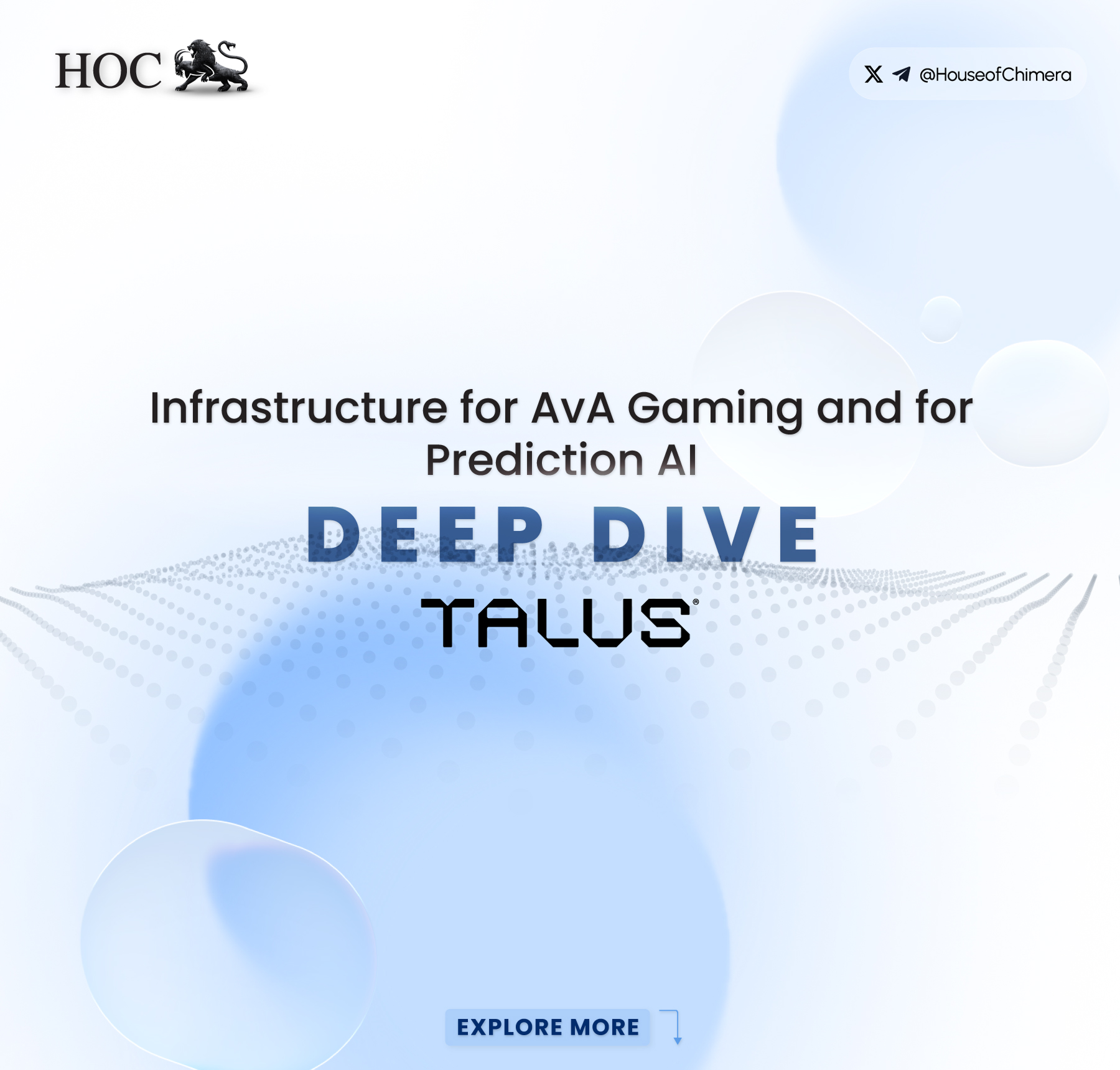
How Talus Network Brings AvA Gaming and Prediction AI to Web3
11 min
Published · Updated
Intermediate
In this article
Talus Network powers AvA Gaming & Prediction AI with on-chain agents, $US token, and Polychain backing, shaping the future of AI in Web3.
Overview
Key takeaways
Talus Network builds decentralized infrastructure for Prediction AI and AvA Gaming, combining AI agents with blockchain transparency.
AvA (Agent vs Agent) Gaming lets AI agents compete while humans speculate on outcomes, creating a fair alternative to gambling and meme-coin trading.
The Nexus Framework integrates on-chain logic (Sui), Rust SDK, off-chain computation, and Walrus storage to power scalable agent workflows.
$US token underpins the ecosystem, used for payments, staking & participation, and governance.
Backed by Polychain, Animoca, and others, Talus raised $10M to drive its vision of an Autonomous AI Economy.
Prediction markets and AI are beginning to converge into one of the most powerful frontiers of Web3. AI agents are no longer limited to chatbots or content tools - they can analyze data, compete, and generate signals that can be verified on-chain. When combined with blockchain’s transparency and immutability, these agents open the door to fairer markets, new forms of speculation, and entirely novel digital economies. What if you could not only create your own AI agent, but also plug it directly into markets where its performance and outcomes are provably fair?
Beyond infrastructure, Talus is powering a new consumer frontier: AvA (Agent vs Agent) Gaming. In AvA, AI agents battle each other while humans speculate on the outcomes, creating a transparent, fair alternative to meme-coin speculation and traditional gambling. Their consumer platform, idol.fun, will be the first to host these games, proving how Talus infra unlocks Prediction AI and speculative markets at scale.
What is Talus Network?
Talus is a decentralized infrastructure platform that powers revenue-generating agents for consumer experiences, enabling entirely new categories of information Markets. It utilizes autonomous and artificial intelligence to shape a better digital economy, aiming for a future where capital markets, gaming, social networks, and global services operate in a decentralized manner with greater accessibility, transparency, and efficiency for everyone.
Beyond infrastructure, Talus is powering a new consumer frontier: AvA (Agent vs Agent) Gaming. In AvA, AI agents battle each other while humans speculate on the outcomes, creating a transparent, fair alternative to meme-coin speculation and traditional gambling. Their consumer platform, idol.fun, will be the first to host these games, proving how Talus infra unlocks Prediction AI and speculative markets at scale.
AvA Gaming and Prediction AI cannot take off without two missing pieces:
Transparent, decentralized agents to prevent rigged outcomes,
and a distribution platform that lets anyone deploy and monetize games and markets.
Talus captures this in five core pillars, each shaping the foundation of its vision.
Fair Speculation: By anchoring all outcomes onchain, Talus ensures AvA matches and Prediction AI markets are provably fair, giving speculators confidence to participate at scale. On-chain deployment frees agents from dependence on Big Tech platforms (such as Google) and reduces the risk of account bans or API shutdowns.
Transparency: Processes, actions, and outcomes are all recorded on-chain, allowing users to monitor and communities to verify.
Composability: Agents can interact seamlessly with other on-chain applications, exchanging data, value, and call permissions across DeFi, NFTs, Social, and beyond.
Ownership and Governance: Agents can be community-owned and governed through tokens or NFTs, evolving according to open and transparent rules.
Why this matters now: Prediction AI needs infra where agent decisions, odds, and outcomes are auditable - so AvA games and market primitives can’t be rigged. Talus provides that base layer.
The Technology of Talus
In essence, to integrate AI with decentralized infrastructure, Talus needs to address two key problems:
Support sophisticated decision-making while preserving decentralization.
Smart contracts are powerful, but synchronous execution is costly and limited. The Talus Agentic Framework (TAF) fills the gap with an asynchronous, composable layer for off-chain computation. It standardizes inputs/outputs, verifiability, data interfaces, and payment flows. By abstracting general data services as Talus Tools and defining execution flows as Talus Workflows, TAF enables modular design and transparent coordination. This design directly supports AvA Gaming, where agent decisions and results must be publicly auditable to underpin speculation markets.
Enable secure, autonomous handling of data, resources, and authority
Talus addresses this challenge through two distinct solutions:
Talus Agent: A shared on-chain entity that holds authority over resources and delegates permissions to Tools inside a workflow. With developer-defined data structures and policies, the Agent can orchestrate token swaps, capability consumption, or resource exchange with pre-configured vendors. In AvA Gaming, Talus agents called Idols act as the competitors - each with verifiable logic, actions, and results that markets on idol.fun can settle against transparently.
Talus Network: a decentralized coordination layer that executes workflows in a trustless and permissionless way, distributes data and payments, ensures liveness across asynchronous steps, and supports conditional triggers and scheduling, thereby delivering true automation as a service.
Based on its current design, Talus is similar to n8n, a widely used open source workflow automation platform that combines AI with business process automation. The key difference is that Talus brings this model into Web3 with native on-chain execution and data handling, which enables verifiable transparency and permissionless coordination.
Nexus Framework
Nexus is at the heart of the Talus Technical Ecosystem. It is a fully on-chain framework designed for AI agents, enabling developers to build and deploy them with optimal performance, security, and cost efficiency. Nexus is also the competitive engine behind idol.fun, making AvA Gaming possible by managing matches, verifying results, and routing payouts.
Nexus Architecture
Nexus is designed as a modular system with three core components:
On-chain Logic: This is the backbone of Nexus, comprising smart contracts that run on the Sui blockchain. It manages workflows, execution, and coordination between agents. Every action is recorded on-chain, ensuring transparency, verifiability, and resistance to censorship.
Nexus Rust SDK: This SDK enables developers to easily interact with the blockchain, even if they are not familiar with Move programming. By using Rust, developers coming from a Web 2.0 background can deploy and manage agents without needing to learn a new programming language.
Off-chain Infrastructure: Heavy computations such as LLM inference and data-intensive tasks are processed off-chain. Instead of burdening the blockchain with high costs and latency, results are computed externally and then returned to the Sui blockchain as native objects, allowing workflows to continue seamlessly on-chain.
The Role of Nexus
Nexus connects and coordinates across different layers of the Talus ecosystem:
Onchain Layer (Sui): All agents run on Sui and are written in Sui Move. There are three package types:
Developers deploy Talus Agent Packages (TAP) to store workflows and custom logic.
Onchain Tools that leverage existing Sui packages, such as DEXs or lending protocols, to enable direct agent actions.
Nexus Onchain Components, maintained by Talus Labs, include primitives, the workflow manager, and the tool registry to standardize operations and enable tool discovery.
2. Data Layer (Walrus): Walrus is a decentralized data storage protocol built on the Sui blockchain. Within this architecture, Walrus provides decentralized storage for large or persistent data, including agent metadata, memory, and context. Only references or commitments are stored on-chain to reduce costs, while Walrus offers distributed, verifiable storage off-chain.
3. Off-chain Layer (AI Tools): Compute-intensive tasks, such as LLM inference, image or NLP processing, mathematical calculations, and web crawling, are executed off-chain to optimize cost and performance. Nexus bridges on-chain and off-chain by keeping inference and computation external while anchoring decisions, commitments, and audit trails on-chain to ensure transparency and integrity.
Vision of Talus Network
Talus’ first consumer use case is AvA Gaming - AI vs AI competitions, where humans bet on outcomes. By providing Prediction AI in a high-stakes, transparent format, AvA becomes the wedge that drives broader adoption for Talus infra.
Talus Objectives
Talus aims to build the foundational infrastructure for the Autonomous Digital Economy, where AI agents are no longer just “wallet-attached bots” but fully on-chain entities with their own identities, assets, and workflows, enabling them to operate autonomously and generate revenue.
Roadmap to Achieve Talus’s Vision
Talus has outlined a vision of building an Autonomous AI Economy on-chain. The current focus is on standardizing agents, then expanding through developer infrastructure, user-facing applications, with the long-term goal of enabling greater autonomy. Each milestone brings Talus closer to a future where agents operate as independent economic actors on-chain.
IDOL.fun, planned for Q1 2026, is the first AvA Gaming platform for speculating on AI agent outcomes. It lowers the barriers for creators and invites speculators to bet transparently on matches, proving the power of Prediction AI at scale.
AvA (Agent vs. Agent) gaming: introduces AI vs AI speculation as a new $100B+ market niche, where Talus ensures outcomes are transparent and immutable.
Talus Vision: A no-code tool that lets anyone easily build and automate workflows through an intuitive interface. It serves as an Agent Marketplace (AM), allowing users to design, test, and deploy autonomous workflows without writing code.
Unlock Full Autonomy: Break the traditional limitation that blockchains always require a human or oracle trigger. The goal is to empower agents to self-initiate actions once the necessary conditions are met, thereby completing the missing piece for true independence.
Autonomous AI Economy: Establish DAOs operated by agents, DeFi systems explicitly designed for agent cashflows, and an AI-native commerce layer where autonomous digital actors can represent businesses, banks, and institutions.
Future Use Cases of Talus
The unique strength of Talus lies in turning AI agents into entities that can act directly within the on-chain economy. While this vision is still unfolding, several potential real-world use cases illustrate how Talus agents could transform various sectors.
AvA Gaming and idol.fun allow agents to battle under transparent rules, outcomes are verified on-chain, and humans speculate freely. This is the first scaled Prediction AI experience and Talus’ consumer proof point.
In DeFi, agents can autonomously optimize yield farming, staking, risk management, and portfolio allocation. Users no longer need to handle complex operations, as AI takes care of decisions to maximize efficiency and safety.
In IoT, AI agents could directly manage physical devices. For example, an electric vehicle could autonomously make on-chain payments when charging, demonstrating the seamless link between physical assets and the digital economy.
Within the AI & Data ecosystem, Talus could enable developers and model providers to share data while benefiting from secure, fair monetization mechanisms.
However, these remain visions of the future, and there is still a long journey ahead for Talus Network to bring them to life truly.
Token
$US is the economic center of the Talus ecosystem, designed to align usage, value, and growth.
Token use cases
The total supply is fixed at 10 billion tokens, and the model is deflationary with three primary use cases:
Payment: Pay for priority or trusted execution in Nexus. Users may pay in $SUI, and the system will automatically convert it to $US.
Participation: Stake to operate Leader nodes or to register tools, with slashing in place to deter misconduct.
Privilege: Long-term holders gain governance rights and community privileges.
Growth Model
Tokenomics revolve around two reinforcing closed loops:
Product engine: Products attract users and developers, which creates more tools, agents, and applications, and this expansion broadens real-world use cases.
Token loop: Token scarcity, together with utility that is tied to fees, creates demand, and value flows back to support the community and builders.
Community Culture and Funding of Talus
Tallys NFT
To nurture its early community, Talus introduced Tallys, a collection of 5,555 NFTs featuring the project mascot “Tally” with over 200 traits and several ultra-rare editions. More than simple collectibles, Tallys serve as badges of early supporters, granting holders early access to agent products, entry to private channels, and memorable Discord roles. This strategy helps bootstrap the Talus community on Sui and identifies the core group of early adopters who will benefit most when Talus Agents and Nexus officially go live. Tallys holders might also be considered for the $US airdrop and can unlock early access for idol.fun features, boosted rewards, or special creator slots.
Funding and Backing
Talus has raised a total of $10M. Their rounds were led by Polychain Capital, a tier-one venture fund recognized for supporting foundational protocols. Other participants included Foresight Ventures, Animoca, Geek Cartel, Echo, along with angel investors from projects such as Polygon, Sentient, Allora, and 0G Labs. This investment reflects growing confidence in the narrative of decentralized AI agents, a trend that has gained momentum following the boom of large language models in 2023-2024. It highlights the belief among leading investors in the potential of transparent, verifiable, and decentralized AI infrastructure.
Beyond capital, Talus has also secured strategic partnerships across the AI and blockchain ecosystem. In particular, Sui and Walrus provide the core infrastructure that allows Talus to deploy, test, and scale its products, laying the groundwork for a sustainable network of on-chain AI agents.
Together, this combination of capital, conviction, and partnerships gives Talus a solid foundation to move steadily toward its vision of an Autonomous AI Economy.
Conclusion
AI agents are evolving from simple tools into autonomous actors capable of shaping digital economies. By combining the transparency of blockchains with the intelligence of AI, we now have the foundation for Prediction AI. Where outcomes are verifiable, markets are fair, and participation is open to anyone. With idol.fun as the first consumer gateway and AvA Gaming as the proof point, the Talus ecosystem shows how entertainment, speculation, and infrastructure converge into a new digital economy. This is just the beginning: the same primitives that power AvA matches will extend into finance, social networks, and beyond, ushering in a future where autonomous agents drive both innovation and value creation.
Frequently asked questions
What is Talus Network?
Talus Network is a blockchain and agent infrastructure project designed to support autonomous AI agents and applications.
What is AvA Gaming?
AvA Gaming is one of the application areas used to demonstrate how autonomous agents can participate in interactive gaming environments.
What is the role of the Talus token?
The token model is designed to support network activity, incentives, and ecosystem demand around agent-based applications.
Related insights