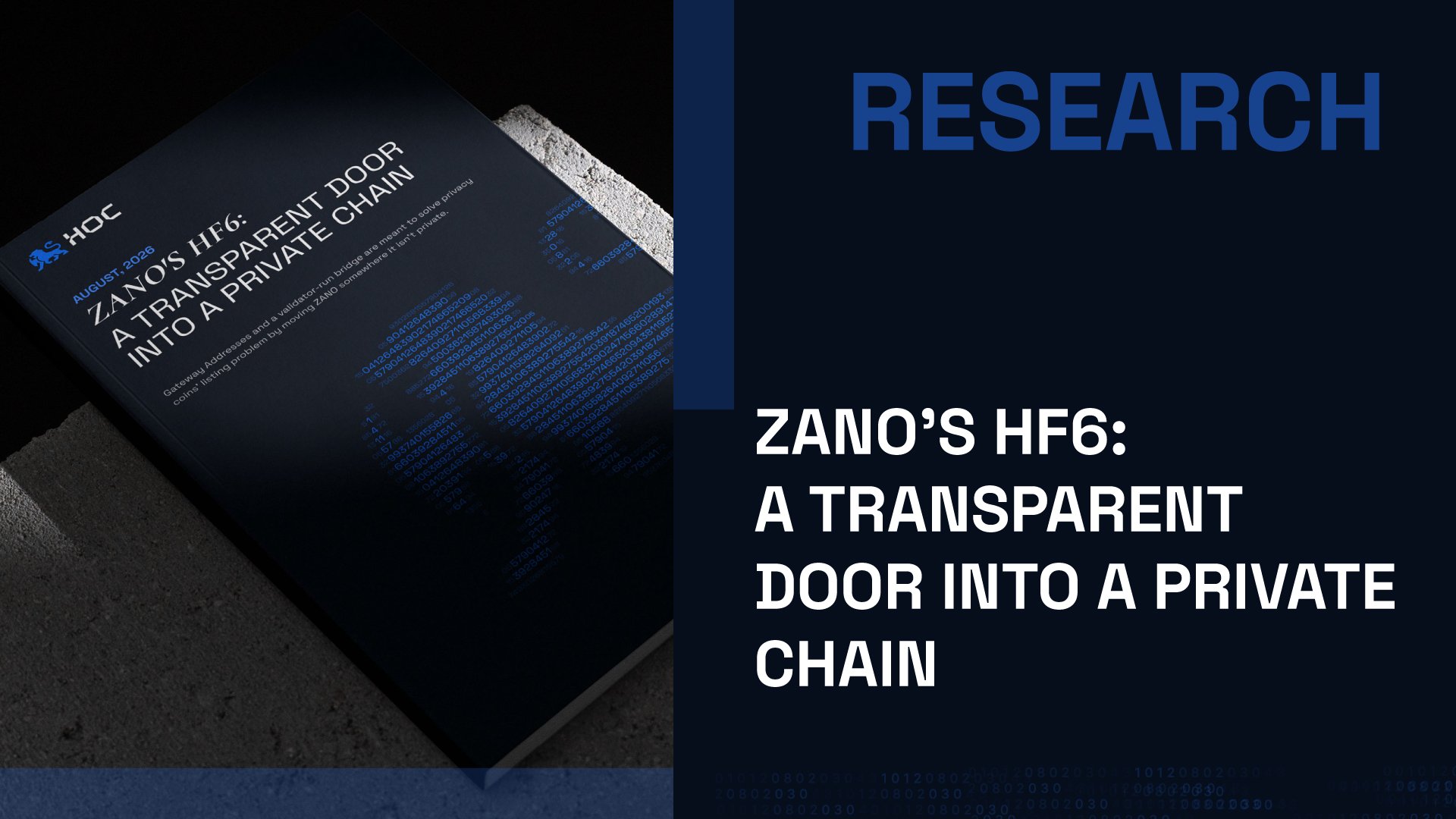
Zano's HF6: A Transparent Door Into a Private Chain
6 min
Published · Updated
Beginner
add FAQ
In this article
Zano's HF6 adds Gateway Addresses and a validator-run bridge to reach exchanges. Native privacy is untouched, but does activity return?
Overview
Key takeaways
Gateway Addresses solve access without touching privacy: Standard Zano addresses stay private. Gateway Addresses are a separate, fully transparent type built for KYC venues, letting wrapped ZANO reach exchanges that would not list a private-by-default chain.
Bridging turns one trust assumption into four: Native ZANO meant trusting Zano's consensus alone. Bridgeless adds the smart contracts, the signature implementation, a validator quorum, and the team running it. Zano calls that validator set "still growing."
Unlike Zcash, Zano's split can lose activity for good: A transparent Zcash transaction still pays Zcash fees. wZANO runs on Ethereum, Solana, or TON, so fees, security, and activity move with it. Nothing pulls that back
Zano, a privacy-focused Layer 1, launched HF6 on 26 August 2026. It targets the problem that has cost privacy coins nearly every major listing: assets that hide balances by default are hard for centralized platforms to integrate and risky to hold when the user cannot be identified.
This report examines the mechanism, the trust it redistributes, and what it could cost the native chain, benchmarked against the two precedents already on record.
WHAT HF6 ACTUALLY CHANGES
Zano's mainnet launched in May 2019 with hybrid Proof-of-Work/Proof-of-Stake consensus and privacy as the default for every transaction, not an opt-in feature. Unlike earlier upgrades, HF6's focus sits outside the native chain.
Its central feature is the Gateway Address, a transparent address type that behaves like an EVM account with one continuously readable balance, which an exchange, bridge, or DEX can connect to without custom engineering. That same feature enables Bridgeless, a cross-chain bridge where tokens lock in a Gateway Address on the Zano side, a validator network confirms the move via threshold signatures, and an equivalent amount mints as wZANO, a standard ERC-20, on Ethereum, Solana, or TON. Reversing the flow burns the wZANO and releases the native coin.
A custodial version of wZANO already existed, run directly by the Zano core team. HF6 replaces it with the validator-based model. Six further changes ship alongside: uniform consensus rules and a clearer fork-choice rule, stronger wallet-file encryption, per-payment reference codes so exchanges can reconcile deposits without exposing recipients, block trial runs for mining pools, new DoS limits, SOCKS5 proxy support, and tighter RPC interfaces.
The two headline features are distribution mechanisms, not privacy upgrades. The native chain remains private and unchanged.
WHAT MONERO LOST AND ZCASH KEPT
Roughly 60 delistings landed in 2024 alone, the most since 2021, and Monero took the brunt: pushed off OKX, Binance, and Kraken and onto smaller venues and P2P rails. Zcash lost OKX too, but its optional transparency gave compliance teams a way to keep it listed elsewhere. Binance already requires ZEC deposits through TEX addresses, a transparent format that proves funds came from outside the shielded pool. That is the same goal as a Gateway Address, reached by different mechanics, and it is the closest available precedent for wZANO.
The risk is not purely regulatory. In August 2025, an L1 called Qubic gained 51% of Monero's mining hashrate and executed a six-block reorganization, prompting Kraken to suspend XMR deposits. Zano's hybrid consensus raises that bar meaningfully, since an attacker would need significant hashpower and significant stake at once, though it does not make the chain immune.
Zcash's shielded-pool share is the other signal worth reading. It sat in single digits for years, then climbed from roughly 8% to over 30% since early 2024, and only once two things happened together: wallets like Zashi and Zodl began defaulting to shielded addresses, and outside demand arrived in the form of Multicoin Capital's disclosed position and a Grayscale ETF filing. The lesson is that a mechanism shipping is not the same as a mechanism being used.
THE REAL COST: COLLATERAL AND SPILLOVER
Network security depends on ZANO being staked, not merely held, because staking requires a synced node actively participating in consensus. ZANO locked as bridge collateral in a Gateway Address does neither; it just sits there. If a significant share of supply shifts from circulating and stakeable to locked, that is arguably worse for security than normal circulation, even while headline "usage" looks healthy.
Native staking has no lock-up, no minimum, and no fixed rate, so yield is a genuine pull back toward the native chain. But the shared-pool mechanic caps how strong that pull gets: as more ZANO is staked, each staker's share shrinks. Yield partially offsets fragmentation. It does not fix it.
That leaves the spillover question. Because wZANO is backed 1:1, more demand for it requires more ZANO locked, and some holders should eventually pivot to the native chain; that awareness effect is arguably the point. The alternative ending is that integrations ship, wZANO gets real usage, and nothing meaningful returns, leaving native Zano as a ghost chain with most activity confined to its wrapper.
THE BOTTOM LINE
HF6 is a careful answer to a real problem, and it leaves native privacy genuinely untouched. Zano has never held a tier-1 listing, and the Zcash precedent shows a transparent variant can keep compliance teams on side, which increases the odds without guaranteeing them.
The open question is not whether wZANO gets adopted. It is whether anything comes back. Zcash never had to ask that question, because its split stayed on one chain. Zano's does not.
Frequently asked questions
What is Zano HF6?
Zano HF6 is a major network upgrade that introduced Gateway Addresses and a validator-based bridging system while keeping standard Zano transactions private.
What are Zano Gateway Addresses?
Gateway Addresses are an account-based address type designed to make Zano easier for exchanges, bridges, DEXs, and other external services to integrate.
How does Zano compare with Zcash?
Zano keeps privacy as the default while adding a separate transparent Gateway Address type, whereas Zcash supports both shielded and transparent transaction models.
Related insights